Using an FSA for Tirzepatide: Eligibility and Claim Steps
Published August 20, 2026

Yes, tirzepatide can be FSA and HSA eligible in the United States when a licensed provider prescribes it for a diagnosed medical condition and you keep the right paperwork. The standard comes from IRS Publication 502, which qualifies prescription medications as eligible medical expenses when tied to treating a disease or condition, not simply a lifestyle goal. Your plan administrator will look for proof of that medical necessity before approving a claim.
- A valid prescription for tirzepatide from a licensed provider
- Documentation linking the prescription to a diagnosed condition (often obesity or a related metabolic diagnosis)
- An itemized pharmacy receipt, and sometimes a Letter of Medical Necessity (LMN)
Telehealth prescriptions count the same as in-person ones. Ozari Health's evaluation process and compounded tirzepatide program are built to produce exactly this kind of documentation, provided your plan's own substantiation rules are met.
Key Takeaways
Tirzepatide qualifies for FSA/HSA reimbursement when a licensed provider documents a diagnosed medical condition and the claim includes a prescription, itemized receipt, and, when requested, a Letter of Medical Necessity.
| Point | Details |
|---|---|
| IRS standard is the test | Publication 502 requires a prescription tied to a diagnosed condition, not a specific brand or formulation. |
| Documentation prevents denials | Itemized receipts, prescriptions, and LMNs address the most common reasons claims get rejected. |
| Compounded drugs face more scrutiny | Compounding pharmacy invoices should clearly list medication, dose, and prescriber to avoid extra questions. |
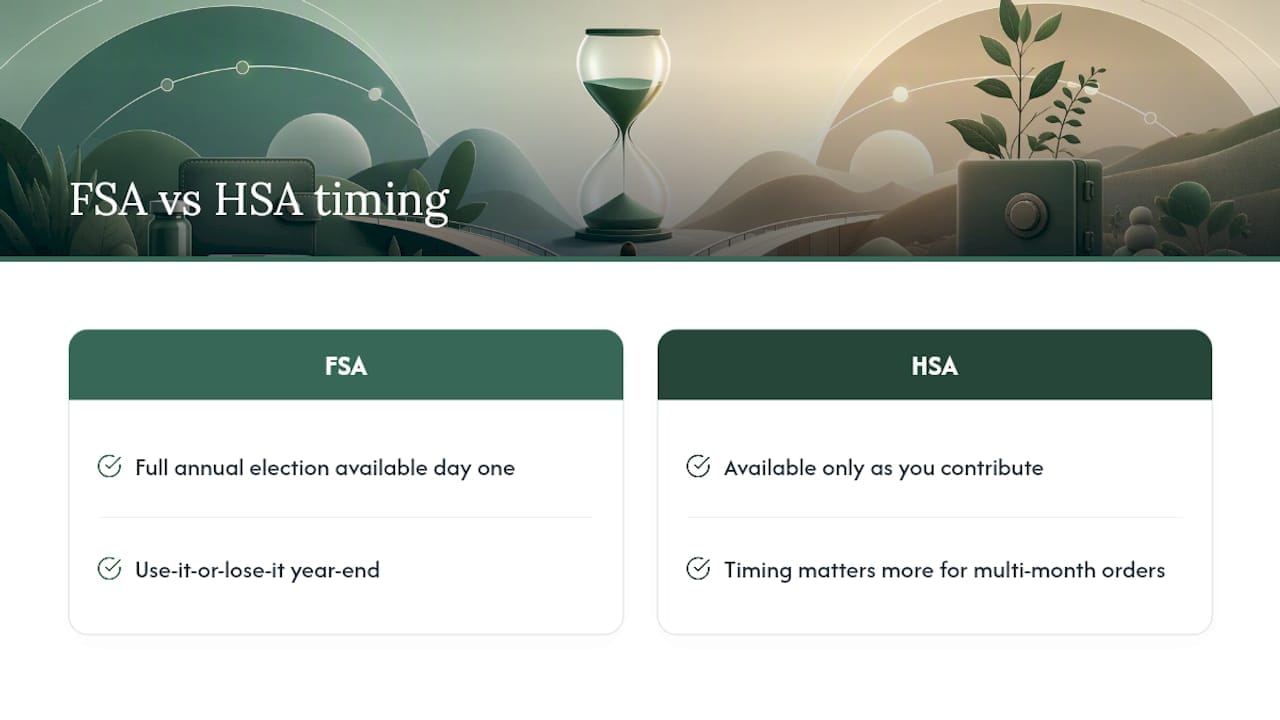
| FSA and HSA timing differs | FSA funds are available day one; HSA funds accrue as contributed, which affects planning for multi-month orders. |
| Ozari Health provides claim-ready paperwork | Prescriptions, itemized invoices, and optional LMNs support FSA/HSA claims for compounded tirzepatide (Ozari One, $125/mo billed quarterly). |
Table of Contents
- Why Tirzepatide Qualifies Under IRS Rules
- What Documentation Your FSA or HSA Administrator Will Ask For
- Does It Matter If Tirzepatide Is Branded or Compounded?
- How to Submit an FSA or HSA Claim for Tirzepatide
- Why Claims Get Denied and How to Protect Yourself
- How Ozari Health Supports Your FSA or HSA Paperwork
- Get a Telehealth Evaluation and the Paperwork You Need
- Sources
- FAQ
Why Tirzepatide Qualifies Under IRS Rules
The IRS does not maintain a list of approved brand names. Publication 502 sets a functional test: a medicine qualifies as a deductible medical expense when it treats a diagnosed disease or condition, and that same logic underpins FSA and HSA eligibility determinations. Tirzepatide prescribed for obesity, prediabetes, or another documented metabolic diagnosis clears that bar. Tirzepatide prescribed with no diagnosis attached, purely for cosmetic weight loss, generally does not.
This distinction matters more than most people realize. Obesity is treated by the CDC as a significant, diagnosable public health condition, which is exactly why clinicians document it the way they document diabetes or hypertension. Plan administrators lean on that diagnosis, not the drug name, when deciding whether to approve your claim.
A few things to keep in mind:
- Eligibility hinges on the prescription plus medical necessity, never on brand, formulation, or where you filled it.
- Some plans require pre-submission of an LMN before you spend a dollar; others only ask for one if your claim gets flagged.
- Filing without adequate documentation risks a denied claim now and a tax problem later if funds get treated as non-qualified.
Pro Tip: Ask your provider to write the ICD-10 diagnosis code and a one-line clinical rationale directly on the prescription or LMN. Administrators move faster when the diagnosis is explicit instead of implied.
What Documentation Your FSA or HSA Administrator Will Ask For
Most denials trace back to missing paperwork, not eligibility itself. Build your claim packet around these four items:
- Itemized pharmacy receipt showing the medication name, fill date, and cost (a credit card statement alone will not work).
- Prescription that specifically names tirzepatide.
- Clinician note or LMN stating the diagnosis, the ICD-10 code, and why tirzepatide is medically appropriate.
- Telehealth visit receipt, if the consult fee itself is being claimed, showing it was a clinical service rather than a general wellness charge.
State telehealth programs generally treat a documented virtual visit the same as an in-person one, and Florida's health department resources outline the kind of visit documentation that holds up under scrutiny. Keep digital or physical copies of everything: pharmacy invoice, LMN, and visit note. If your plan ever audits the claim, you want to produce that packet in minutes, not weeks.
Pro Tip: Request a provider-signed LMN that spells out diagnosis, ICD-10 code, expected treatment duration, and clinical rationale in one document. One clean LMN beats three scattered notes.
Does It Matter If Tirzepatide Is Branded or Compounded?
The IRS test does not change based on pharmacy type. Whether your prescription fills as Mounjaro, Zepbound, or a compounded tirzepatide formulation, eligibility still depends on the prescription and the documented diagnosis, not the label on the vial.
In practice, compounded medications sometimes draw more scrutiny because they lack the same regulatory registration as brand-name drugs, and Forbes Health notes that administrators may ask for more detailed backup in these cases. A compounding pharmacy receipt should clearly name the medication, dose, and prescribing provider, mirroring what a branded pharmacy receipt already shows. Ozari Health's compounded tirzepatide program issues itemized invoices formatted with that detail in mind, which cuts down on the back-and-forth some patients hit with vaguer paperwork.
How to Submit an FSA or HSA Claim for Tirzepatide
- Pay for the prescription, either by swiping your HSA debit card at the pharmacy or paying out of pocket if you plan to file a manual reimbursement.
- Gather your documents: prescription, itemized receipt, and LMN if your plan requires or might request one.
- Submit through your plan portal or by mail, attaching every document as a single packet rather than piecemeal.
- Track the response window. Most administrators respond within a couple of weeks; if a claim is denied, it typically comes with a specific reason.
- Appeal promptly by resubmitting with the missing item and a short cover note tying the prescription to the diagnosis.
Swiping your HSA card at checkout is faster, but a manual claim gives you the chance to attach an LMN up front, which lowers your odds of an automatic flag. Injectco's practical guidance on GLP-1 claims recommends exactly this: submit everything together the first time instead of waiting to see what gets questioned.
Pro Tip: Bundle the prescription, LMN, and itemized receipt into one PDF before you submit. A single combined packet resolves most substantiation requests before they're even sent.
Why Claims Get Denied and How to Protect Yourself
Denials cluster around a small set of causes: a prescription with no diagnosis attached, a wellness-program fee billed with no clinical service behind it, a receipt that isn't itemized, or a plan that simply requires an LMN nobody provided. Forbes Health points out that plans lean harder on documentation when the diagnosis isn't diabetes, which is exactly the situation most tirzepatide-for-weight-loss patients are in.

FSAs and HSAs also behave differently in ways that affect your risk. An FSA typically makes your full annual election available on day one, while HSA funds are only available as you contribute them, so timing a multi-month tirzepatide order matters more with an HSA. FSA dollars also carry "use it or lose it" pressure at year end. Reimbursing an ineligible expense without proper documentation risks tax penalties down the line, so if a claim comes back denied, resubmit with the LMN and a short note connecting the prescription to your diagnosis rather than letting the deadline lapse.
How Ozari Health Supports Your FSA or HSA Paperwork
Ozari Health's telehealth evaluation is built to generate the documents administrators actually ask for: a signed prescription, an itemized pharmacy invoice, and a clinician visit note, with an LMN available on request when your plan requires one. Compounded tirzepatide through Ozari Health is $125/mo on Ozari One, billed $375 every 3 months, and compounded semaglutide is $86/mo, billed $258 every 3 months, both with published all-in pricing and no insurance paperwork to navigate. Ozari One ships to every state except California; California patients use Ozari Select, $145/mo billed quarterly for semaglutide or $199/mo for tirzepatide.
- Prescription and itemized invoice generated after your provider evaluation
- Clinician visit note documenting the clinical basis for treatment
- Optional Letter of Medical Necessity if your plan requests one
- Shipping timelines designed to align with typical FSA/HSA claim windows
This content was medically reviewed by Dr. Michael Wasef, MD, Board-Certified in Internal Medicine (Florida License ME125730). Ozari Health's compounded medications are not FDA-approved and are not generic versions of branded drugs; they are prepared by licensed U.S. compounding pharmacies for individual patients under a valid prescription.
A Note on Getting This Right the First Time
Medical necessity and clean paperwork win claims, not the brand name on the vial. Line up your prescription, diagnosis, and receipts before you file, and treat ongoing clinical supervision, not a guaranteed number on the scale, as the point of the visit.
Get a Telehealth Evaluation and the Paperwork You Need
Chasing down a prescription, an itemized invoice, and a Letter of Medical Necessity from three different places is where most FSA and HSA claims fall apart, not the eligibility rules themselves. Ozari Health's telehealth evaluation is built to hand you all three in one place: a licensed provider reviews your history, writes the prescription if appropriate, and your compounded tirzepatide order ships with an itemized invoice already formatted for reimbursement.
If you're ready to start, check availability and pricing for compounded tirzepatide in your state, where Ozari One is $125/mo, billed $375 every 3 months, with no hidden fees. Reimbursement still depends on documented medical necessity and your specific plan's rules, so keep every receipt and note your provider gives you.
This article is for informational purposes only and does not constitute medical or tax advice. Consult your plan administrator or a tax professional about your specific FSA/HSA eligibility.
Sources
- Publication 502 (2025), Medical and Dental Expenses | Internal Revenue Service
- Cdc
- GLP-1s: FSA & HSA Eligibility – Forbes Health
- HSA/FSA For Semaglutide & Tirzepatide (2026): What's Covered & What Gets Denied
Always confirm details against your own plan documents or with your plan administrator before filing.
This article is general information, not a substitute for advice from a qualified doctor. Consult a qualified healthcare professional about your own circumstances before acting on anything here.
FAQ
Is Tirzepatide FSA or HSA Eligible?
Yes, tirzepatide is FSA and HSA eligible when prescribed by a licensed provider for a diagnosed medical condition and backed by proper documentation, per IRS Publication 502.
Can I Use My HSA for Semaglutide Too?
Yes, semaglutide follows the same IRS standard as tirzepatide: a prescription tied to a diagnosed condition qualifies, and Ozari Health's compounded semaglutide program is $86/mo on Ozari One, billed $258 every 3 months.
Does a Telehealth Prescription Count for FSA/HSA Purposes?
Yes, a telehealth prescription and visit note carry the same weight as an in-person visit as long as the documentation shows a genuine clinical evaluation and diagnosis.
What Should I Do if My Claim Gets Denied?
Request a Letter of Medical Necessity from your provider, resubmit with a short cover note linking the prescription to your diagnosis, and include the itemized receipt again if it wasn't clearly attached the first time.
Which GLP-1 Medication Is Most Effective for Weight Loss?
Effectiveness varies by patient, dose, and adherence, and no medication guarantees a specific result; a licensed provider should evaluate your history to determine whether tirzepatide, semaglutide, or another option fits your situation.
Related Articles
Men: Fella Health Safety Risks, Real Costs, and an $86 Alternative
A safety-first look at Fella Health for men: why compounded GLP-1s show higher FDA reporting risks, how to calculate all-in monthly cost, and an $86 Ozari...
Read more →generalHallandale Semaglutide vs Tirzepatide: What Patients Should Know
Compare the compounded semaglutide and tirzepatide formulations Hallandale currently lists, including concentrations, regulatory status, dosing differences, and Ozari fulfillment.
Read more →generalHallandale Pharmacy Shipping: Delivery, Packaging & Storage Guide
How Hallandale Pharmacy fulfillment works, what to check when a GLP-1 shipment arrives, storage guidance, delays, and Ozari order support.
Read more →