$299 Flat vs $86/mo Quarterly: Remedy Meds Pricing and Transparency
Published September 2, 2026
Remedy Meds publicly lists compounded semaglutide at $299 per month and compounded tirzepatide at a flat monthly price, with unlimited video visits bundled into that flat fee and no insurance accepted. Ozari Health publishes lower prices: compounded semaglutide at $86/mo and compounded tirzepatide at $125/mo on Ozari One, billed $258 or $375 every 3 months, through named compounding pharmacy partners. Ozari One ships to every state except California; California patients use Ozari Select, $145/mo billed quarterly for semaglutide or $199/mo for tirzepatide. Readers who want a lower published price and pharmacy transparency tend to fit Ozari Health better; readers who want a single flat number that never changes with dose may prefer Remedy Meds' model.
TL;DR:
- Remedy Meds offers a fixed monthly price of $299 for semaglutide and $399 for tirzepatide, regardless of dose, which benefits patients on titration schedules.
- Ozari Health's prices are lower: Ozari One $86/mo for semaglutide and $125/mo for tirzepatide, billed quarterly; Ozari Select $145/mo or $199/mo billed quarterly, or $175/mo and $235/mo billed monthly.
- Remedy Meds includes unlimited provider video visits in the flat fee, which can improve adherence during dose escalation, while some platforms charge per visit or cap consults.
- Both providers do not accept insurance for compounded medications, but Ozari Health publishes pharmacy details and certifies LegitScript, enhancing transparency and trust.
- Actual costs can vary based on additional fees like lab work, shipping, or supply costs, and timely shipping or cancellation policies differ across platforms.
Table of Contents
- Remedy Meds Pricing Reviews: The Quick Comparison
- What Remedy Meds Publicly Lists About Pricing and Policies
- Ozari Health's Published Pricing and Pharmacy Standards
- Which Pricing Differences Actually Matter for Cost and Safety?
- How Should You Choose a GLP-1 Telehealth Provider?
- What Do Reviewers and Patients Say About Remedy Meds?
- Branded GLP-1s vs Compounded: Why the Price Gap Exists
- What Fees Show Up Beyond the Headline Monthly Price?
- How Long Does Delivery Take After You Order?
- How Does Billing and Cancellation Actually Work?
- When Does Ozari Health's Pricing Make More Sense?
- Start With Transparent Pricing You Can Actually Verify
- Sources
- FAQ
- The 12-Month Math
- Red Flags — Avoid These Providers
Remedy Meds Pricing Reviews: The Quick Comparison
Before diving into policy details, here is how the two platforms stack up on the numbers that actually drive a monthly bill. Remedy Meds keeps one price no matter the dose you're prescribed. Ozari Health's published pricing is lower and depends on the medication and plan: Ozari One is $86/mo for semaglutide or $125/mo for tirzepatide, billed quarterly.
| Provider | Semaglutide (monthly) | Tirzepatide (monthly) | What's included | Insurance accepted | Pharmacy transparency |
|---|---|---|---|---|---|
| Remedy Meds | $299/mo | $399/mo | Medication, unlimited video visits, shipping | Not accepted (U.S. News) | Not consistently published |
For context, branded GLP-1s carry a different pricing structure entirely. Retail list prices for products like Ozempic and Wegovy commonly run well into the hundreds of dollars per month before manufacturer coupons or insurance adjustments, which is the underlying reason cash-pay compounded options exist at all. Ozari Health's branded Ozempic cost breakdown walks through that retail math in more detail.
The headline gap between Remedy Meds' $299/mo and Ozari One's $86/mo (billed quarterly) is real, but it's not the whole story. Remedy Meds' flat rate does not increase if a provider titrates a patient to a higher tirzepatide dose, while compounded pricing elsewhere in the market sometimes scales with dose strength. That trade-off matters more for some patients than others, and it's worth understanding before enrolling in either model.
What Remedy Meds Publicly Lists About Pricing and Policies
Remedy Meds' own marketing and independent reviews describe a straightforward checkout structure: pick a medication, pay the flat monthly rate, and the fee covers both the prescription and ongoing provider access. Based on publicly available reporting, here's what's documented:
- Compounded semaglutide lists at $299 per month; compounded tirzepatide lists at a flat monthly price.
- The monthly fee bundles unlimited video visits with a provider, rather than charging per-consult.
- U.S. News confirms Remedy Meds does not accept insurance, consistent with the cash-pay telehealth GLP-1 category broadly.
- No separate membership or platform fee appears in the publicly listed pricing beyond the flat monthly rate.
- Independent reviewers note pricing is transparent at checkout, though some coverage points out that named compounding pharmacy partners aren't always published on the same pages as pricing.
- Refund and cancellation terms are described by third-party reviewers as available, but Remedy Meds' own cancellation policy page was not independently verifiable for this article. That last gap is worth sitting with. Pricing transparency and pharmacy transparency are two different things, and a provider can be fully forthcoming about one while staying vague on the other.
Ozari Health's Published Pricing and Pharmacy Standards
Ozari Health lists compounded semaglutide at $86/mo and compounded tirzepatide at $125/mo on Ozari One, billed $258 or $375 every 3 months, figures that sit meaningfully below Remedy Meds' flat-rate model. Those prices come directly from Ozari Health's own compounded semaglutide state pages and are not averaged or estimated.
What separates the pricing conversation from the trust conversation is what backs the number. Ozari Health publishes:
- Named compounding pharmacy partners on its pharmacy standards page, rather than leaving fulfillment sourcing unstated.
- LegitScript-related certification claims tied to its fulfillment model, per the same pharmacy standards documentation.
- Ongoing clinical support for dosing adjustments, side-effect management, and refill scheduling, included in the monthly fee rather than billed separately.
- HSA and FSA eligibility for payment, alongside standard card payment, with no insurance billing required.
Pro Tip: Before comparing any two GLP-1 telehealth platforms on price alone, check whether each one names its compounding pharmacy by name on its own site. A published starting price means little if you can't verify who is actually filling the prescription.
Compounded semaglutide and tirzepatide are not FDA-approved products and are not generic versions of branded drugs like Ozempic, Wegovy, Mounjaro, or Zepbound. They're prepared by licensed compounding pharmacies under a provider's prescription, which is a materially different regulatory category worth understanding before you enroll anywhere.
The 12-Month Math
Remedy Meds, year one: $299 × 12 = $3,588.
Ozari, year one, semaglutide: Ozari One is $86/mo, billed $258 every 3 months. $258 × 4 = $1,032.
Ozari, year one, tirzepatide: Ozari One is $125/mo, billed $375 every 3 months. $375 × 4 = $1,500.
Against Ozari One's semaglutide plan the difference is $2,556 across twelve months ($3,588 vs $1,032), for the same medication category and the same flat, all-in pricing model; Ozari One renews every 3 months with no annual prepay and no membership fee. Verify current pricing directly with Remedy Meds.
Which Pricing Differences Actually Matter for Cost and Safety?
Two platforms can list similar-sounding services and still produce very different real-world costs and experiences. A few structural differences carry more weight than the headline number.
Flat pricing versus dose-based pricing. Remedy Meds' flat monthly rate means a patient titrated up to a higher tirzepatide dose pays the same $399 as someone on a starting dose. That's a genuine advantage for predictability. Providers with dose-based compounded pricing, by contrast, may see the monthly bill climb as a provider increases the dose during titration, which is common with GLP-1 medications over the first several months of treatment.
Named pharmacy partners versus unnamed fulfillment. Verifying both LegitScript certification and the actual compounding pharmacy's state license is a legitimate step before enrolling with HIPAA-compliant telehealth platforms providers should vet first, and the absence of a named partner is a fair reason to ask more questions, not necessarily a disqualified on its own.
Unlimited video access during titration. Forbes Health's review of Remedy Meds highlights that unlimited video visits included in the monthly fee is a meaningful service difference from platforms that cap consults or charge per visit. Synchronous video contact with a clinician during dose escalation, when side effects like nausea or gastrointestinal discomfort are most common, can influence whether a patient sticks with treatment.
A quick note on adherence: platforms offering more synchronous clinician access during titration tend to see fewer patients drop off early, according to reporting on Remedy Meds' service model. That's not a guarantee of outcomes, but it's a real factor in why "unlimited visits" isn't just a marketing line.
Shipping speed and refill reliability. A missed refill shipment doesn't just delay a dose. It can interrupt titration schedules that providers designed around steady weekly or biweekly dosing, which matters clinically as much as it matters logistically.
Insurance realities for branded options. Neither Remedy Meds nor Ozari Health bills insurance for compounded medications, which is standard for this category. Patients whose insurance does cover branded GLP-1s like Wegovy or Zepbound may find that route cheaper after coverage, and should discuss that possibility with their own insurer and a licensed clinician before assuming compounded is automatically the lower-cost path for them specifically.
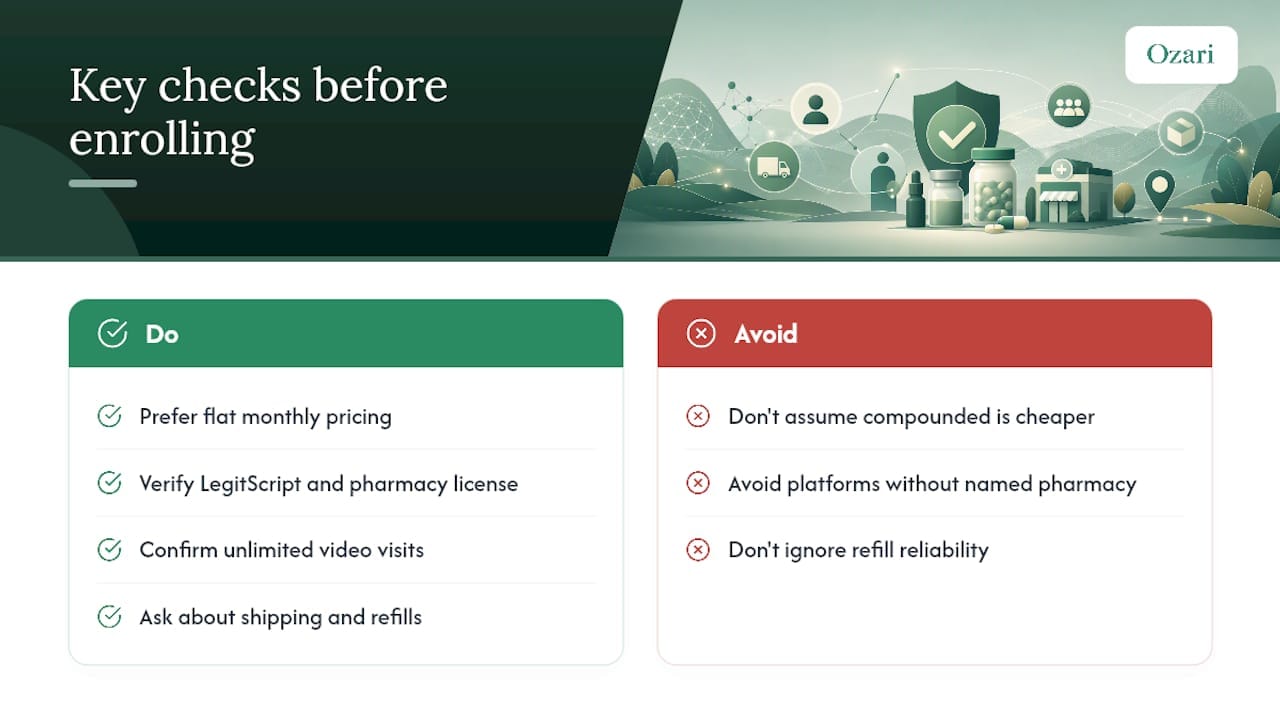
Before you pay any provider, check it against the eight red flags that rule out a GLP-1 provider.
Neither Remedy Meds nor Ozari does these things. Some sellers do. Walk away from any provider that:
- Ships GLP-1s with no prescription and no provider review
- Advertises "generic Ozempic" — no generic semaglutide exists in the US
- Claims compounded medications are FDA-approved (they are not)
- Will not name the pharmacy that fills your prescription
- Sells "research use only" peptides for human injection
- Guarantees a specific amount of weight loss
How Should You Choose a GLP-1 Telehealth Provider?
Before enrolling with any GLP-1 telehealth platform, run through this checklist:
- Confirm the compounding pharmacy is named and licensed. If a provider's site doesn't list who fills the prescription, ask directly before paying.
- Check for LegitScript certification or equivalent verification. This is a baseline trust signal in telehealth pharmacy, not a nice-to-have.
- Read the refund and cancellation policy before checkout, not after your first charge posts.
- Ask about shipping SLA and what happens if a shipment is delayed near a scheduled dose date.
- Confirm how clinician access works, specifically whether visits are unlimited, capped, or billed separately from the base medication fee.
- Add up the real monthly total, including any lab work, diagnostic screening, or supply fees that sit outside the advertised headline price.
Pro Tip: Ozari Health's GLP-1 cost calculator is built for exactly this step: plug in the medication and plan to see the full monthly total before you commit, rather than estimating from the headline price alone.
Marketing red flags worth watching across the telehealth GLP-1 industry generally include vague "as low as" pricing that never resolves to an exact number at checkout, and language implying guaranteed weight-loss results. No compounded GLP-1 provider can promise a specific outcome, and any marketing that does deserves a second look. If a platform pressures same-day enrollment or discourages you from checking with an independent clinician first, pause before proceeding.
What Do Reviewers and Patients Say About Remedy Meds?
Third-party reviews of Remedy Meds cluster around a few consistent themes. On the positive side, reviewers point to fast onboarding, checkout pricing that matches what's advertised with no surprise line items, and responsive customer support during the initial enrollment process.
On the complaint side, recurring themes in independent coverage include:
- Shipping timelines that some patients report running longer than expected during high-demand periods.
- Occasional confusion or disputes around refund requests, particularly when a patient cancels mid-cycle.
- Questions about pharmacy sourcing, since some reviewers note that compounding partner names aren't consistently published alongside pricing pages.
"Pricing is transparent at checkout, but the underlying compounding pharmacy relationship isn't always spelled out in the same place," one independent review summary notes of the broader flat-rate compounded GLP-1 category.
Anecdotal reviews and structured review platforms tell you different things. A high review count and strong average rating suggest most transactions go smoothly, but they don't verify pharmacy sourcing or confirm licensing. Weigh both types of evidence, and treat unverifiable claims about "hidden costs" or "fake reviews" with the same skepticism you'd apply to unverified praise.
Branded GLP-1s vs Compounded: Why the Price Gap Exists
Branded GLP-1 medications like Ozempic, Wegovy, Mounjaro, and Zepbound carry manufacturer pricing, patent protection, and marketing costs baked into their retail price. Compounded semaglutide and tirzepatide, prepared by licensed compounding pharmacies under a provider's prescription, avoid that overhead structure, which is the core reason compounded options list at a fraction of branded retail pricing.
That lower price comes with a trade-off: compounded medications are not FDA-approved products, and they are not generic equivalents of the branded drugs. The NCBI clinical overview of GLP-1 receptor agonists and peer-reviewed literature on GLP-1 agent efficacy and side effects both underscore why ongoing clinician monitoring matters regardless of which pricing model a patient chooses.
Neither Remedy Meds nor Ozari Health bills insurance for compounded medications, and both operate as cash-pay platforms. HSA and FSA funds typically apply to qualified medical treatment, which can offset the out-of-pocket cost for either provider; check your specific plan's eligibility rules first. Speak with a licensed clinician about your individual health history before starting any GLP-1 medication, branded or compounded.
What Fees Show Up Beyond the Headline Monthly Price?
The advertised monthly number rarely tells the full story. Most cash-pay GLP-1 telehealth platforms, Remedy Meds and Ozari Health included, structure their published price around the medication and standard provider access, but a few categories of cost sit outside that headline figure industry-wide.
Initial consultation and intake. Some platforms fold the first provider evaluation into the monthly fee; others bill it separately as a one-time intake charge. Confirm which model applies before checkout.
Lab work and diagnostic screening. Providers sometimes require baseline bloodwork before prescribing, particularly for patients with existing metabolic conditions. Whether that cost is included, discounted, or billed to the patient separately varies by platform and is worth asking about directly.
Shipping beyond standard delivery. Standard shipping is typically included in the base monthly fee across this category, but expedited or signature-required delivery can carry an added charge depending on the provider and the patient's location.
Dose escalation costs. This is where flat-rate and dose-based models diverge most. A flat-rate platform like Remedy Meds doesn't raise the price when a provider increases the dose. A dose-based model may. That single structural difference can swing the real annual cost by hundreds of dollars depending on where a patient lands on the titration schedule.
Supplies. Needles, alcohol swabs, and sharps disposal containers are sometimes included and sometimes billed as an add-on. Read the fine print on what "included" actually covers before you compare two headline prices as if they're apples to apples.
How Long Does Delivery Take After You Order?
Time from order placement to medication arriving at your door depends on several moving parts, not just the shipping carrier. Most cash-pay GLP-1 telehealth platforms follow a similar sequence: intake form, provider review, prescription approval, pharmacy compounding, then shipment.

The provider review step is usually the fastest, often completed within a day or two once a patient submits their intake information and any required health history. The compounding step is where timelines vary most. Because compounded medications are prepared to order rather than pulled from mass-manufactured inventory, pharmacy processing can add several business days before a package even ships.
Factors that commonly extend the timeline include incomplete intake forms requiring follow-up, high order volume at a given pharmacy, and standard versus expedited shipping selection at checkout. Patients who submit complete health information up front and choose expedited shipping when available generally see the shortest end-to-end timeline. Weather-related shipping delays and address verification issues are the two most common causes of delays once a package has shipped, and they affect every carrier and every provider in this space, not one platform specifically.
If a first shipment runs later than a platform's stated estimate, that's a fair reason to contact support directly and ask for a tracking update before assuming something has gone wrong.
How Does Billing and Cancellation Actually Work?
Cash-pay GLP-1 telehealth platforms typically bill through standard credit or debit card processing, with some also supporting HSA or FSA cards where the platform is set up to accept them. Ozari Health accepts HSA and FSA payment alongside standard card payment for its published pricing.
Subscriptions in this category generally auto-renew monthly unless a patient actively cancels before the next billing cycle. That structure is standard across the telehealth GLP-1 industry, not unique to any single provider, but it means the burden falls on the patient to track their own billing date if they intend to pause or stop.
Before enrolling anywhere, confirm three things directly with the provider: how many days before the renewal date you need to cancel to avoid the next charge, whether a partial refund is available if you cancel mid-cycle after a shipment has already gone out, and whether pausing (rather than fully canceling) is an option if you just need a temporary break. Policies on these questions vary by platform, and Remedy Meds' specific cancellation mechanics were not independently verifiable from public policy pages for this article. Always confirm current terms directly on the provider's own policy page before enrolling, since billing terms can change.
Remedy Meds publishes its cancellation process in its account settings or help center; confirm the cancellation in writing and check your next statement. Ozari's cancellation terms are published at https://www.ozarihealth.com/refund-policy
When Does Ozari Health's Pricing Make More Sense?
Cost-sensitive patients who want a published price below $100 a month for semaglutide (Ozari One, $86/mo billed quarterly), and who value knowing exactly which compounding pharmacy is filling their prescription, tend to be the best fit for Ozari Health's model. Patients who want ongoing clinical support for dosing questions and side-effect management, without paying a separate membership fee on top of the medication cost, also tend to land well here.
Ozari Health backs its pricing with a published pharmacy standards page naming its compounding partners and describing its LegitScript-related fulfillment claims, rather than asking patients to take transparency on faith. That said, price and pharmacy transparency are only part of the decision. Confirm your own medical eligibility with a licensed provider before enrolling with any GLP-1 telehealth platform, compounded or branded.
— Ozari Health Editorial Team
Start With Transparent Pricing You Can Actually Verify
Choosing between the two models comes down to what you value most: a single monthly number, or a lower price backed by named pharmacy partners you can check yourself. Ozari Health publishes both: compounded semaglutide at $86/mo and compounded tirzepatide at $125/mo on Ozari One, billed $258 or $375 every 3 months, with no insurance billing required and no separate membership fee layered on top.
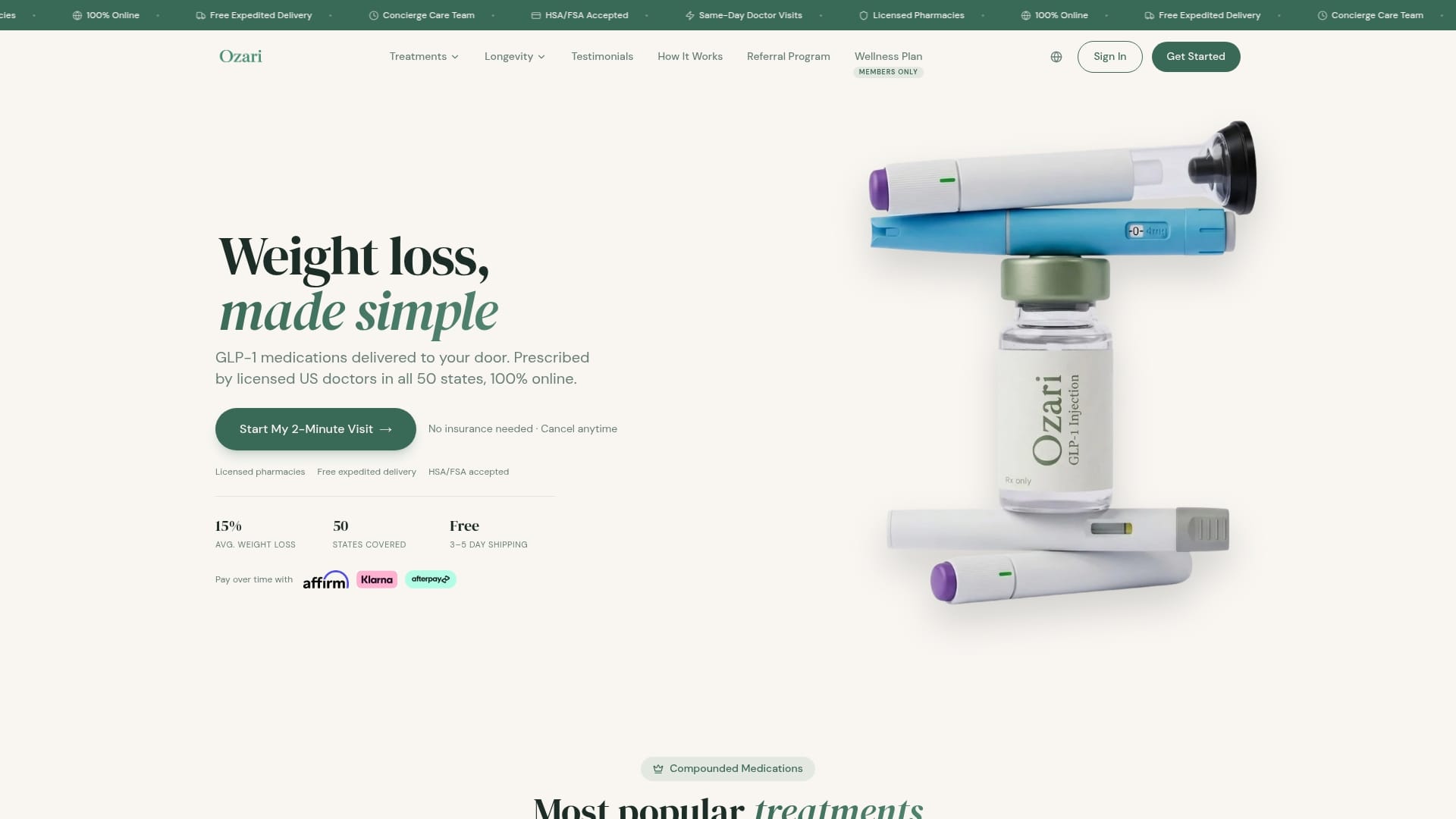
Every plan includes provider evaluation, ongoing clinical support for dosing and side effects, and fulfillment through named compounding pharmacy partners listed on Ozari Health's pharmacy standards page. HSA and FSA cards are accepted alongside standard payment methods. If you're ready to see current pricing for your state, start with compounded semaglutide by state or explore the buy compounded semaglutide page to review a 3-month supply option and next steps.
This article is general information, not a substitute for advice from a qualified doctor. Consult a qualified healthcare professional about your own circumstances before acting on anything here.
Sources
- Remedy Meds Weight Loss Review (2026) — Forbes Health
- Remedy Meds GLP-1s for Weight Loss Review 2026 — U.S. News
- GLP-1 receptor agonists — NCBI Bookshelf
- Peer-reviewed article on GLP-1 agents — PMC
- Ozari true-cost breakdown: https://www.ozarihealth.com/true-cost/remedy-meds
- FDA, concerns about unapproved GLP-1 drugs used for weight loss: https://www.fda.gov/drugs/drug-alerts-and-statements/fdas-concerns-unapproved-glp-1-drugs-used-weight-loss
Related reading
FAQ
How much does Remedy Meds cost per month?
Remedy Meds lists compounded semaglutide at $299 per month and compounded tirzepatide at a flat monthly price, with unlimited video visits included in that flat fee.
Does Remedy Meds charge a monthly membership fee?
Based on public reporting, Remedy Meds does not list a separate membership fee beyond its flat monthly medication price, though the same caveat applies to any policy details not independently verifiable on Remedy Meds' own site.
Why is compounded pricing lower than branded GLP-1 pricing?
Compounded semaglutide and tirzepatide avoid the manufacturer, patent, and marketing overhead built into branded drug pricing, which is why compounded options list well below branded retail prices; they are not FDA-approved products or generic versions of the branded drugs.
How trustworthy is Remedy Meds?
Remedy Meds' pricing is reported as transparent at checkout by multiple independent reviewers, though some coverage notes that named compounding pharmacy partners aren't always published alongside its pricing pages, which is a fair verification step before enrolling.
Is Ozari Health's pricing cheaper than Remedy Meds?
Ozari One is $86/mo for semaglutide and $125/mo for tirzepatide, billed $258 or $375 every 3 months, which sits below Remedy Meds' $299 and $399 flat monthly rates; Remedy Meds' rate stays fixed regardless of dose changes during titration.
Is Remedy Meds legitimate?
Remedy Meds requires licensed provider review and discloses that compounded medications are not FDA-approved, per its published pages. Verify its LegitScript status at legitscript.com and its pharmacy licensure before ordering.
This article is for informational purposes and does not constitute medical advice. Compounded semaglutide and compounded tirzepatide are not FDA-approved medications and are not generic versions of branded drugs such as Ozempic, Wegovy, Mounjaro, or Zepbound. Individual results vary, and no weight-loss outcome is guaranteed. Consult a licensed clinician to determine whether any GLP-1 medication is appropriate for your health history before starting treatment. Reviewed by Dr. Michael Wasef, MD.
Is Remedy Meds legitimate?
Remedy Meds requires licensed provider review and discloses that compounded medications are not FDA-approved, per its published pages. Remedy Meds states it holds LegitScript certification; you can confirm that at legitscript.com and check its pharmacy licensure before ordering.
Related Articles
Men: Fella Health Safety Risks, Real Costs, and an $86 Alternative
A safety-first look at Fella Health for men: why compounded GLP-1s show higher FDA reporting risks, how to calculate all-in monthly cost, and an $86 Ozari...
Read more →generalHallandale Semaglutide vs Tirzepatide: What Patients Should Know
Compare the compounded semaglutide and tirzepatide formulations Hallandale currently lists, including concentrations, regulatory status, dosing differences, and Ozari fulfillment.
Read more →generalHallandale Pharmacy Shipping: Delivery, Packaging & Storage Guide
How Hallandale Pharmacy fulfillment works, what to check when a GLP-1 shipment arrives, storage guidance, delays, and Ozari order support.
Read more →