Tirzepatide Side Effects: What You Need to Know
Published July 16, 2026

TL;DR:
- Tirzepatide commonly causes gastrointestinal side effects like nausea, diarrhea, and vomiting that are dose-dependent and temporary. Serious events such as pancreatitis, gallbladder disease, and kidney injury are rare but require immediate medical attention. Managing side effects involves slow dose escalation, dietary adjustments, hydration, and personalized medical guidance.
Tirzepatide side effects are defined as the adverse physical responses that occur when the body adjusts to this dual GIP/GLP-1 receptor agonist, most commonly presenting as nausea, diarrhea, vomiting, and constipation. These gastrointestinal reactions are dose-dependent, meaning they intensify as your dose increases, and they are typically temporary during the escalation phase. The FDA has reviewed extensive clinical trial and post-marketing data on these adverse events, establishing clear prescribing guidelines to help patients and providers manage them. Understanding what to expect before you start treatment is the most direct way to make an informed decision about whether tirzepatide is right for you.
What are the common tirzepatide side effects?
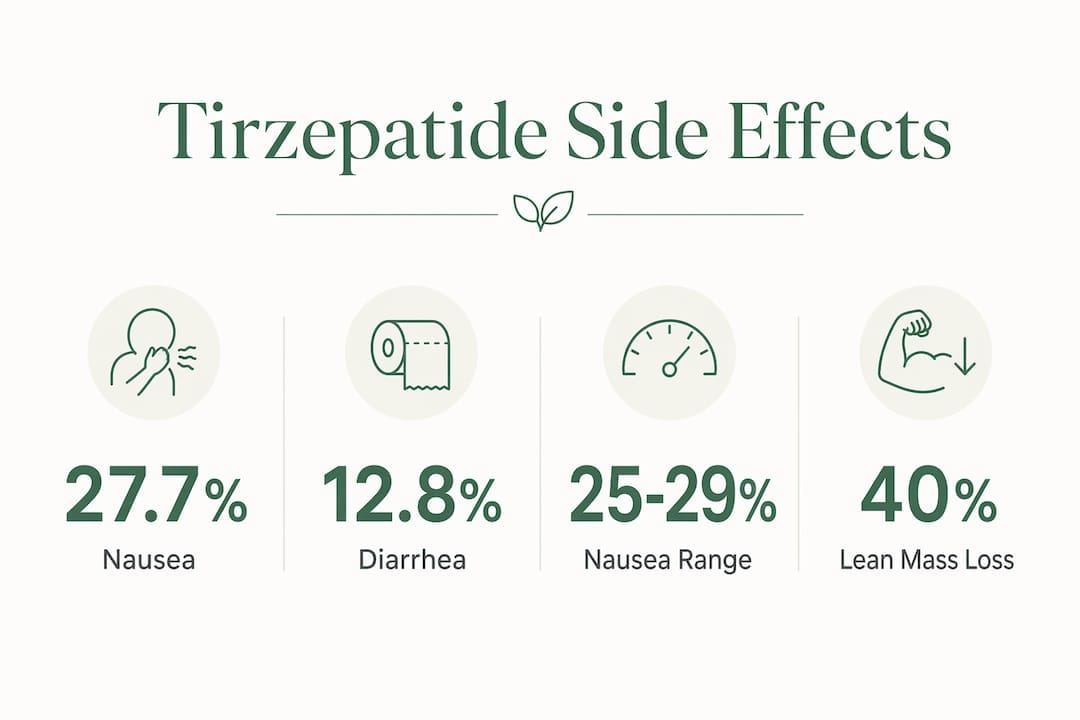
Gastrointestinal symptoms are the most frequently reported adverse effects of tirzepatide. Nausea affects 25–29% of patients, with rates rising toward 45% at higher doses. That dose-dependent pattern means patients on 15 mg experience more nausea than those on 5 mg, which is why the standard titration schedule exists.

Real-world FAERS data from Q2 2022 to Q2 2024 show nausea at 27.7% and diarrhea at 12.8% among reported events. GI symptoms typically begin within 16 days of starting treatment and occur most often within the first three months. Most patients find that symptoms ease once the body adapts to a given dose level.
The table below summarizes the most commonly reported adverse effects and their approximate frequency ranges from clinical trial data:
| Side effect | Approximate frequency | Typical timing |
|---|---|---|
| Nausea | 25–45% | First 2–4 weeks at each dose |
| Diarrhea | 19–23% | First 2–4 weeks at each dose |
| Constipation | 11–17% | Variable, often early in treatment |
| Vomiting | 8–13% | First 2–4 weeks at each dose |
| Injection site reactions | 3–7% | Shortly after injection |
Beyond GI symptoms, patients also report:
- Fatigue: A less common but documented effect, often linked to reduced caloric intake during early treatment.
- Headache: Typically mild and transient, often resolving within the first few weeks.
- Hair thinning: More common in patients experiencing rapid weight loss, particularly women.
- Injection site reactions: Redness, swelling, and itching occur in 3–7% of patients and are generally mild and short-lived.
Lean mass loss is a clinically relevant concern that many patients overlook. Approximately 40% of total weight lost on tirzepatide therapy comes from lean mass rather than fat alone. Patients who prioritize muscle preservation should discuss resistance training and protein intake with their provider from the start.
Which serious tirzepatide risks should patients know about?
Serious adverse events are rare but real. The FDA prescribing information for tirzepatide includes a boxed warning for thyroid C-cell tumors based on rodent studies. Tirzepatide is contraindicated in patients with a personal or family history of medullary thyroid carcinoma or Multiple Endocrine Neoplasia syndrome type 2. This warning applies to all patients regardless of dose.
Beyond the boxed warning, the following serious adverse events require awareness:
- Acute pancreatitis: Occurs at less than 1% of patients but demands immediate attention. The hallmark symptom is severe, persistent abdominal pain that radiates to the back. This pain is distinct from ordinary GI discomfort and should prompt an emergency evaluation.
- Severe GI obstruction: Rare but documented, particularly in patients with pre-existing GI motility conditions.
- Acute kidney injury: Often a downstream consequence of dehydration caused by vomiting and diarrhea. Dehydration events are disproportionately represented in serious outcome reports, underscoring the need for consistent fluid intake.
- Gallbladder disease: Gallbladder-related events occurred in 1.1% of tirzepatide patients versus 0.4% in placebo groups across pooled clinical trials. Rapid weight loss accelerates gallstone formation, making this a meaningful risk for patients losing weight quickly.
- Hypotension: Patients on antihypertensive medications may experience blood pressure drops as weight decreases, requiring medication adjustments.
Pro Tip: If you experience severe abdominal pain that does not improve within a few hours, stop eating and drinking and go to an emergency room. Do not wait to see if it resolves on its own.
Seek immediate medical attention for any of the following: severe or persistent vomiting, signs of dehydration such as dark urine or dizziness, sudden vision changes, or difficulty swallowing.
How do tirzepatide adverse effects vary by patient group?
Not all patients experience the same side effect profile. Patients with type 2 diabetes report higher rates of GI disorders than those using tirzepatide solely for weight management. This difference likely reflects the interaction between the medication and pre-existing metabolic conditions, as well as concomitant medications.
Subgroup differences documented in FAERS analyses include:
- Diabetes vs. weight management patients: GI adverse event frequency is higher in the diabetes subgroup, which affects how providers should counsel patients at the start of treatment.
- Sex differences: Males report more GI adverse events overall, while females are more likely to report hair thinning, which correlates with the greater relative weight loss seen in women.
- Older adults: Patients over 65 face a higher risk of dehydration-related complications because kidney function and fluid reserves decline with age.
- Patients on multiple medications: Concomitant use of antihypertensives, diuretics, or other GI-affecting drugs amplifies certain risks, particularly hypotension and electrolyte imbalance.
These differences matter for clinical counseling. A 35-year-old woman using tirzepatide for weight management needs different monitoring guidance than a 60-year-old man managing type 2 diabetes on three other medications. Personalized monitoring is not optional. It is the standard of care.
Side effect patterns differ meaningfully between the diabetes and weight management populations, which is why a one-size-fits-all approach to patient education falls short. Your provider should review your full medication list and health history before finalizing a titration plan.
What strategies effectively manage tirzepatide side effects?
The most effective approach to managing GI adverse effects is a slow, structured dose escalation. The standard titration schedule increases the dose by 2.5 mg every four weeks, giving the GI tract time to adapt at each level. Most nausea and vomiting peak during dose increases and then subside.
Follow these steps to minimize discomfort during treatment:
- Eat smaller, lower-fat meals. Large or high-fat meals slow gastric emptying further, compounding nausea. Aim for three to four small meals per day rather than two large ones.
- Stay hydrated consistently. Drink water throughout the day, not just when thirsty. Dehydration from GI symptoms can escalate quickly into a serious complication.
- Address constipation proactively. Increase dietary fiber intake, drink adequate fluids, and consider an osmotic laxative such as polyethylene glycol if constipation persists beyond a few days.
- Manage diarrhea with loperamide if needed. Over-the-counter loperamide is an appropriate short-term option for loose stools. Persistent diarrhea lasting more than 48 hours warrants a call to your provider.
- Rotate injection sites. Injecting at rotated sites on the abdomen, thigh, or upper arm reduces localized reactions and prevents lipohypertrophy, a thickening of tissue that can impair absorption.
- Slow your titration if needed. Staying at one dose level for eight or more weeks is a recognized clinical strategy when side effects are intolerable at the standard pace. This is not a treatment failure. It is a legitimate path to long-term tolerability.
- Communicate with your provider. Report any symptoms that feel severe, unusual, or persistent. Do not adjust your dose without guidance.
Pro Tip: Inject tirzepatide on a consistent day each week, and time it for evenings when possible. If nausea peaks in the hours after injection, sleeping through the worst of it reduces the perceived burden significantly.
You can learn more about safe prescribing practices in our guide on getting tirzepatide online safely.
Key Takeaways
Tirzepatide's GI side effects are dose-dependent, typically transient, and manageable with slow titration, dietary adjustments, and consistent provider communication.
| Point | Details |
|---|---|
| GI effects are most common | Nausea, diarrhea, vomiting, and constipation affect the majority of patients, especially during dose increases. |
| Serious events are rare but real | Pancreatitis, gallbladder disease, and kidney injury require prompt recognition and medical attention. |
| Subgroup risk varies | Diabetes patients and older adults face higher GI burden; females report more hair thinning. |
| Slow titration is the primary tool | Extending time at each dose level reduces GI intensity without compromising treatment outcomes. |
| Dehydration is an underrated risk | Consistent fluid intake prevents the cascade from GI symptoms to acute kidney injury. |
The Ozari Health editorial team's view on managing tirzepatide side effects
The clinical literature on tirzepatide is clear on one point that does not get enough attention in patient-facing content: most people who discontinue tirzepatide early do so because of GI side effects that were both predictable and preventable. The data show that these symptoms peak during dose escalation and then resolve. Patients who stop at week three because of nausea are often stopping right before the adaptation window closes.
What the trials cannot fully capture is the psychological weight of feeling sick every week. That experience is real, and it deserves direct acknowledgment. The practical answer is not to push through blindly. It is to slow down deliberately. Staying at 2.5 mg or 5 mg for an extra four weeks is not a setback. It is a clinical decision that improves long-term adherence.
The subgroup data also tells a story that individual providers need to act on. A patient with type 2 diabetes on metformin and an ACE inhibitor carries a meaningfully different risk profile than a metabolically healthy adult using tirzepatide for weight management. Treating those two patients identically is a failure of personalized medicine, not a feature of it.
The most underused tool in side effect management is a proactive conversation before the first injection. Patients who understand that nausea is expected, temporary, and manageable tolerate it far better than those who encounter it without warning. Education at the point of prescribing is not optional. It is the single highest-leverage intervention available.
— Ozari Health Editorial Team
Ozari Health and compounded tirzepatide with clinical support
Managing tirzepatide adverse effects is easier when you have a licensed provider guiding your titration from day one. Ozari Health connects patients across all 50 states with licensed clinicians who review your health history, set an appropriate starting dose, and adjust your plan based on how you respond.

Compounded tirzepatide through Ozari Health is $125/mo on Ozari One, billed $375 every 3 months, fulfilled through licensed US compounding pharmacies with no insurance required and no hidden fees. Ozari One ships to every state except California; California patients use Ozari Select, $199/mo billed quarterly for tirzepatide. Ongoing clinical support covers dosing adjustments, side effect management, and refills. Ozari Health is LegitScript certified and publishes all-in pricing transparently. Patients who want a medically supervised path to tirzepatide without navigating insurance can review full treatment details and check availability by state.
Medical disclaimer: This article is for informational purposes only and does not constitute medical advice. Consult a licensed healthcare provider before starting or adjusting any medication. Reviewed by Dr. Michael Wasef, MD, Board-Certified Internal Medicine, Florida License ME125730.
FAQ
What are the most common tirzepatide side effects?
Nausea, diarrhea, vomiting, and constipation are the most frequently reported adverse effects, with nausea occurring in 25–29% of patients and rising with higher doses. These symptoms typically peak during dose escalation and resolve as the body adapts.
How long do tirzepatide GI side effects last?
GI symptoms generally begin within 16 days of starting treatment and are most intense during the first two to four weeks at each dose level. Most patients see significant improvement once they stabilize at a given dose.
Is tirzepatide safe for long-term use?
Tirzepatide carries an FDA boxed warning for thyroid C-cell tumors based on rodent data and is contraindicated in patients with a history of medullary thyroid carcinoma. Serious adverse events like pancreatitis occur in less than 1% of patients, and ongoing monitoring by a licensed provider is the standard approach for long-term use.
Can you reduce tirzepatide side effects by changing your dose?
Slowing the titration schedule is a recognized clinical strategy. Remaining at one dose for eight or more weeks allows GI adaptation without being considered a treatment failure, and many patients tolerate higher doses well after a longer adjustment period.
Does tirzepatide cause hair loss?
Hair thinning is a documented but less common effect, most often linked to rapid weight loss rather than a direct drug mechanism. It is more frequently reported in women and typically improves as weight loss stabilizes.
Sources
Related Articles
Men: Fella Health Safety Risks, Real Costs, and an $86 Alternative
A safety-first look at Fella Health for men: why compounded GLP-1s show higher FDA reporting risks, how to calculate all-in monthly cost, and an $86 Ozari...
Read more →generalHallandale Semaglutide vs Tirzepatide: What Patients Should Know
Compare the compounded semaglutide and tirzepatide formulations Hallandale currently lists, including concentrations, regulatory status, dosing differences, and Ozari fulfillment.
Read more →generalHallandale Pharmacy Shipping: Delivery, Packaging & Storage Guide
How Hallandale Pharmacy fulfillment works, what to check when a GLP-1 shipment arrives, storage guidance, delays, and Ozari order support.
Read more →