Metabolic Adaptation and Weight Loss: What You Need to Know
Published July 10, 2026

TL;DR:
- Metabolic adaptation is the body's way of reducing energy expenditure beyond weight loss predictions, making plateaus common. It results from hormonal and neural changes that conserve energy during calorie deficits, but it is reversible over time with proper management. Using resistance training, adequate protein, structured diet breaks, and medications like GLP-1 support helps mitigate its effects.
Metabolic adaptation is defined as the additional decline in energy expenditure that occurs beyond what weight loss alone predicts, representing the body's active defense against a sustained calorie deficit. This phenomenon, also called adaptive thermogenesis, explains why weight loss plateaus occur even when patients maintain their diet. Research shows that metabolic adaptation accounts for up to 40% of the total reduction in energy expenditure during caloric restriction. That figure means a meaningful portion of your slowing calorie burn is not simply because you weigh less. Understanding what is metabolic adaptation in weight loss, and why it happens, is the first step toward managing it effectively.
What is metabolic adaptation in weight loss?
Metabolic adaptation is the body's regulated, measurable reduction in calorie burn that exceeds what a smaller body size would predict. When you lose weight, your body requires fewer calories simply because it has less mass to maintain. Metabolic adaptation goes further. The body actively reduces energy expenditure as a survival response to prolonged calorie restriction, independent of body composition changes.
The clinical term for this process is adaptive thermogenesis. Controlled studies of weight-reduced patients show they burn significantly fewer calories than weight-matched individuals who never dieted. This gap persists even after accounting for the loss of fat and muscle. The practical result is a weight loss plateau that feels unexplainable despite consistent effort.
Understanding metabolic rate in this context requires separating two distinct processes. The first is the predictable drop in metabolism from having a smaller body. The second is the additional, adaptive suppression the body imposes on top of that. Both slow weight loss, but only the second qualifies as true metabolic adaptation.
What physiological mechanisms drive metabolic adaptation?
The hormonal changes behind metabolic adaptation are well documented. Leptin drops 40–50% within the first week of dieting, signaling the brain that energy stores are depleting. That rapid drop triggers a cascade of compensatory responses across multiple systems.
The key hormonal and physiological drivers include:
- Leptin reduction: Leptin signals the hypothalamus to reduce energy expenditure and increase hunger. Its rapid decline during dieting amplifies appetite and slows metabolism simultaneously.
- Thyroid hormone (T3) suppression: T3 governs the rate of cellular metabolism. Caloric restriction reduces circulating T3, slowing energy use in nearly every tissue.
- Sympathetic nervous system downregulation: Reduced sympathetic activity lowers heart rate, body temperature, and overall energy output.
- Skeletal muscle efficiency: Muscles become more metabolically efficient during a deficit, meaning they perform the same work while burning fewer calories.
- NEAT suppression: Non-exercise activity thermogenesis decreases by 200–400 kcal/day during calorie restriction. This includes unconscious movements like fidgeting and posture shifts, which drop without deliberate awareness.
Metabolic adaptation is a protective efficiency mechanism, not a broken metabolism. The body is doing what it evolved to do when it senses prolonged energy scarcity.
This distinction matters. Metabolic adaptation is not a sign that something has gone wrong. It is a coordinated biological response designed to keep you alive during periods of food scarcity. The problem is that this ancient defense mechanism conflicts directly with modern weight loss goals.
Pro Tip: Track your daily step count alongside your diet. NEAT suppression is largely unconscious, and a step tracker can reveal when your body is quietly compensating for your calorie deficit by reducing background movement.

How is metabolic adaptation measured?
Measuring metabolic adaptation requires separating two overlapping causes of metabolic slowdown. The first is the drop in resting metabolic rate (RMR) caused by losing fat-free mass (FFM), particularly muscle. The second is the additional suppression caused by adaptive thermogenesis itself.
Research using indirect calorimetry and controlled body composition assessments shows that FFM decline accounts for roughly 65% of total RMR reduction in clinical trials, with metabolic adaptation accounting for approximately 35%. That split tells clinicians that preserving muscle mass is the single most effective way to limit metabolic slowdown during a diet.
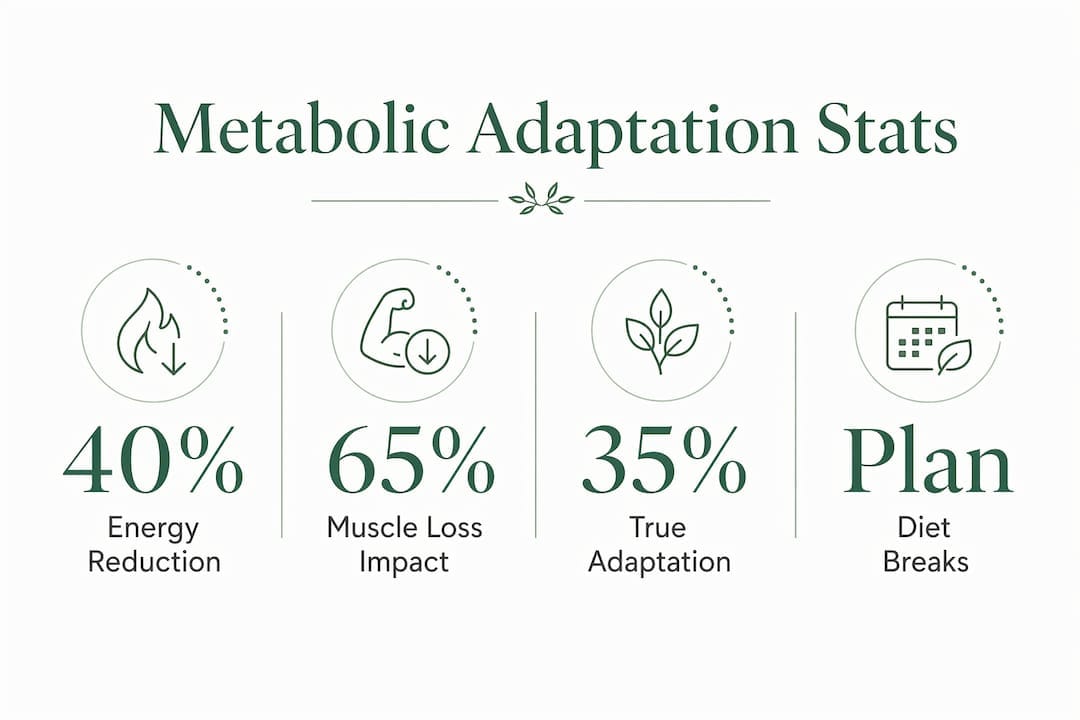
| Cause of RMR reduction | Approximate contribution | Primary driver |
|---|---|---|
| Fat-free mass (muscle) loss | ~65% | Body composition change |
| Adaptive thermogenesis | ~35% | Hormonal and neural adaptation |
| Total RMR reduction | 100% | Combined effect |
Measuring metabolic adaptation in practice requires comparing a patient's observed RMR against a predicted RMR based on their current body composition. The gap between predicted and observed values represents the adaptive component. This measurement is complicated by the fact that different prediction equations produce different baselines, which is why clinical findings on the magnitude of adaptation vary across studies.
The clinical implication is clear. Patients who interpret all metabolic slowing as adaptation may unnecessarily cut calories further, which worsens the adaptation response. Differentiating metabolic adaptation from body composition-driven changes prevents that error and protects long-term adherence.
Pro Tip: If your weight loss has stalled, request an RMR test at a clinical or sports medicine facility before cutting calories further. Knowing your actual metabolic rate prevents unnecessary restriction that deepens adaptation.
What strategies reduce the impact of metabolic adaptation?
Mitigating the impact of dieting on metabolism requires a structured approach across nutrition, training, and diet structure. No single intervention eliminates adaptation, but combining several evidence-backed strategies significantly reduces its magnitude.
-
Prioritize protein intake. Protein intake of 1.6–2.2 g/kg body weight combined with resistance training preserves up to 93% of lean mass during caloric restriction. Preserving lean mass directly limits the FFM-driven component of metabolic slowdown.
-
Train with resistance exercise. Resistance training signals the body to retain muscle even in a calorie deficit. It also maintains mitochondrial density in muscle tissue, which supports a higher resting metabolic rate over time.
-
Use structured diet breaks. The MATADOR trial demonstrated that diet breaks of 1–2 weeks at maintenance calories, taken every 4–12 weeks, reduce adaptive thermogenesis and improve long-term adherence. Diet breaks work by temporarily restoring leptin, T3, and sympathetic nervous system activity toward baseline levels.
-
Cycle calories strategically. Alternating between moderate deficit phases and maintenance phases prevents the hormonal environment from locking into a sustained starvation signal. This approach reduces cumulative cortisol exposure and helps prevent the consolidation of starvation signaling in the hypothalamus.
-
Avoid excessive calorie restriction. Excessive calorie restriction worsens symptoms including fatigue, cold intolerance, hunger, and poor sleep. These symptoms are direct consequences of deepening metabolic adaptation, not signs that the diet is working harder.
-
Incorporate refeeds. Shorter refeed periods of 1–3 days at maintenance calories can partially restore leptin and reduce hunger between diet breaks. Refeeds are less effective than full diet breaks at reversing adaptation but are easier to implement within a weekly structure.
The most common mistake patients make is responding to a weight loss plateau by cutting calories further. That response deepens adaptation and reduces adherence. The evidence-backed response is a structured diet break followed by a return to a moderate deficit.
Pro Tip: Schedule your diet breaks in advance rather than waiting until motivation fails. Planned maintenance weeks feel like a reward rather than a setback, which improves psychological adherence over a 6–12 month weight loss program.
How do GLP-1 medications interact with metabolic adaptation?
GLP-1 receptor agonists like tirzepatide and semaglutide do not eliminate metabolic adaptation, but they address the behavioral and hormonal factors that make adaptation so difficult to manage. Understanding this distinction is important for anyone considering medication-assisted weight loss.
Clinical trial data on tirzepatide shows the following effects relevant to metabolic adaptation:
- Increased fat oxidation: Tirzepatide shifts the body's fuel preference toward fat burning, which supports weight loss even as total energy expenditure declines.
- Appetite suppression: By reducing hunger signals, GLP-1 agonists make it easier to maintain a calorie deficit without the psychological burden of constant hunger driven by low leptin.
- No direct reversal of adaptive thermogenesis: Clinical trials confirm that tirzepatide does not eliminate metabolic adaptation in humans. The adaptation still occurs, but the medication supports adherence to the calorie deficit despite it.
- Sustained deficit adherence: GLP-1 agonists support weight loss by controlling appetite and increasing fat oxidation, enabling patients to maintain the deficit that metabolic adaptation works to close.
The practical implication is that GLP-1 medications work alongside the body's adaptation response rather than overriding it. Patients using these medications still benefit from resistance training, adequate protein intake, and structured diet breaks. Medication reduces the friction of adherence. It does not replace the physiological strategies that preserve metabolic rate. For a detailed review of how these medications work at the hormonal level, the role of GLP-1 in weight loss is covered in depth by Ozari Health's clinical team.
Key Takeaways
Metabolic adaptation is a measurable, reversible suppression of energy expenditure that accounts for up to 40% of the calorie burn reduction seen during dieting, and managing it requires preserving lean mass, using structured diet breaks, and maintaining realistic expectations.
| Point | Details |
|---|---|
| Adaptation is not damage | The body suppresses metabolism as a survival response, not because something has gone wrong. |
| FFM loss drives most slowdown | Fat-free mass loss accounts for roughly 65% of RMR reduction; protecting muscle limits this. |
| Diet breaks reduce adaptation | MATADOR trial evidence supports 1–2 week breaks every 4–12 weeks to restore suppressed hormones. |
| GLP-1 medications aid adherence | Tirzepatide and semaglutide support deficit adherence but do not directly reverse adaptive thermogenesis. |
| Adaptation is reversible | Stable maintenance eating and resistance training restore suppressed metabolic rates over months. |
The Ozari Health editorial perspective on metabolic adaptation
The most persistent misconception we encounter is that a weight loss plateau means the diet has stopped working. Patients interpret stalled progress as a personal failure or a sign that their metabolism is permanently damaged. Neither is accurate. Metabolic adaptation is a normal, time-limited biological response. It is also reversible with weight stability and proper nutritional support over months.
What concerns us more than adaptation itself is the response it provokes. Patients who cut calories aggressively in response to a plateau deepen the very adaptation they are trying to escape. The evidence consistently points in the opposite direction: eat at maintenance for a structured period, train with resistance, and return to a moderate deficit. That cycle produces better long-term outcomes than continuous restriction.
The other insight worth stating plainly is that patience is a clinical strategy, not a platitude. Metabolic adaptation persists for months post weight loss, but it does not persist indefinitely. Physique athletes who reverse diet after competition demonstrate measurable recovery of suppressed metabolic rates over a structured maintenance period. That same recovery is available to anyone who approaches weight management with the same discipline applied to the deficit phase.
— Ozari Health Editorial Team
Compounded GLP-1 medications through Ozari Health
For patients whose weight loss has stalled despite consistent effort, medically supervised GLP-1 therapy provides a clinically grounded next step. Metabolic adaptation makes sustained calorie deficits harder to maintain. GLP-1 receptor agonists address the appetite and hormonal factors that make that deficit feel unsustainable.

Ozari Health connects cash-pay patients with licensed providers across all 50 states. Compounded semaglutide is $86/mo on Ozari One, billed $258 every 3 months, and compounded tirzepatide is $125/mo on Ozari One, billed $375 every 3 months, with no insurance required and no hidden fees. Ozari One ships to every state except California; California patients use Ozari Select, $145/mo billed quarterly for semaglutide or $199/mo for tirzepatide. Medications are fulfilled through licensed US compounding pharmacies and delivered directly to you. Ozari Health holds LegitScript certification and publishes all-in pricing with named pharmacy partners. Review the full GLP-1 medication FAQ to understand eligibility, dosing, and what to expect from treatment.
Medical disclaimer: This article is for informational purposes only and does not constitute medical advice. Consult a licensed healthcare provider before starting any weight loss medication or program. Reviewed by Dr. Michael Wasef, MD, Board-Certified Internal Medicine, Florida License ME125730.
FAQ
What is metabolic adaptation in weight loss?
Metabolic adaptation is the additional reduction in energy expenditure that occurs during caloric restriction beyond what weight loss alone predicts. It is driven by hormonal changes including drops in leptin, T3, and sympathetic nervous system activity.
How does metabolism affect weight loss plateaus?
As the body adapts to a calorie deficit, it reduces total energy expenditure through hormonal suppression and NEAT reduction, closing the gap between calories consumed and calories burned. This is the primary biological cause of weight loss plateaus.
Can metabolism be reset after metabolic adaptation?
Metabolic adaptation is reversible. Research shows that stable maintenance eating combined with resistance training restores suppressed metabolic rates over months, with full recovery documented in controlled studies of weight-reduced individuals.
How much of metabolic slowdown is true adaptation versus muscle loss?
Fat-free mass loss accounts for approximately 65% of resting metabolic rate reduction during dieting, while adaptive thermogenesis accounts for roughly 35%. Preserving lean mass through protein intake and resistance training limits the larger portion of metabolic slowdown.
Do GLP-1 medications like semaglutide prevent metabolic adaptation?
GLP-1 receptor agonists do not directly prevent metabolic adaptation. Clinical trials confirm that adaptation still occurs during GLP-1 therapy, but these medications support adherence by suppressing appetite and increasing fat oxidation despite the adaptation response.
Sources
Related Articles
Men: Fella Health Safety Risks, Real Costs, and an $86 Alternative
A safety-first look at Fella Health for men: why compounded GLP-1s show higher FDA reporting risks, how to calculate all-in monthly cost, and an $86 Ozari...
Read more →generalHallandale Semaglutide vs Tirzepatide: What Patients Should Know
Compare the compounded semaglutide and tirzepatide formulations Hallandale currently lists, including concentrations, regulatory status, dosing differences, and Ozari fulfillment.
Read more →generalHallandale Pharmacy Shipping: Delivery, Packaging & Storage Guide
How Hallandale Pharmacy fulfillment works, what to check when a GLP-1 shipment arrives, storage guidance, delays, and Ozari order support.
Read more →