Online Weight Loss Clinic Fees Explained for 2026
Published July 9, 2026

TL;DR:
- Online weight loss clinic fees often exceed advertised prices once medication, lab work, and shipping costs are included. The median monthly cost at maintenance doses is about 1.63 times higher than the initial advertised price, causing unexpected expenses. Transparent programs publish full, upfront fee schedules, making cost expectations clearer and more reliable.
Online weight loss clinic fees are defined as the total monthly costs patients pay for telehealth-based weight management, including medication, consultations, lab work, and shipping. Most programs advertise a low starting price, but the real monthly expense is often far higher once all charges are included. GLP-1 telehealth programs, which prescribe compounded semaglutide or compounded tirzepatide, have become the dominant model in virtual weight loss care. Understanding how these fees are structured is the first step toward choosing a program that fits your budget without surprises.
What factors make up online weight loss clinic fees?

Online weight loss clinic pricing is rarely a single number. Most programs bundle several distinct cost categories, and each one can vary significantly between providers.
The core components of virtual weight loss program costs include:
- Medication cost: The largest line item for most patients. Compounded semaglutide and compounded tirzepatide are the most common GLP-1 options in telehealth. Branded versions like Wegovy cost $1,349/month without insurance. Compounded alternatives through telehealth cost significantly less, though prices vary by provider and dose.
- Membership or subscription fee: Many programs charge a separate monthly or quarterly platform fee ranging from $99 to $199, on top of medication costs.
- Consultation fees: Telehealth consultations typically run $50–$150, compared to $200–$400 for in-person visits. Follow-up visits may or may not be included in the base price.
- Lab work: Providers often require bloodwork before prescribing. Lab fees range from $0 to $500 depending on whether the clinic accepts external labs or mandates its own.
- Shipping charges: Most programs ship medication directly to patients. Shipping fees of $15–$25 per order are common and are often not disclosed upfront.
- Dose escalation surcharges: As patients move from starter doses to maintenance doses, many programs charge more per vial or per month.
- Add-on services: Supplements, nutrition coaching, and behavioral support are frequently offered as upsells that inflate the total cost.
Pro Tip: Ask any program to send you a written fee schedule that covers the maintenance dose, not just the starter dose. If they cannot provide one, that is a red flag.
The most transparent programs publish all fees on a single pricing page before you complete an intake form. Programs that require you to log in or submit personal information before revealing costs are more likely to carry hidden charges.
How do advertised prices differ from real monthly costs?
The gap between advertised and actual pricing in online weight loss programs is measurable and significant. The median maintenance-dose price is 1.63 times the advertised introductory price, with a median dollar gap of $150 per month. That means a program advertising $199/month may realistically cost $325 or more once you reach a therapeutic dose.
The mechanism behind this gap is the starter dose tactic. Programs advertise the price of the lowest titration dose, typically 0.25 mg semaglutide for the first four weeks. Patients escalate to maintenance doses within one to three months, and the cost rises 30–50% at that point. The advertised price is technically accurate but reflects a dose that most patients use for only a few weeks.
"The maintenance dose price is a more realistic measure for budgeting monthly fees than the starter dose promoted as the advertised price. Patients who budget based on introductory pricing are routinely caught off guard when their second or third invoice arrives."
The table below illustrates how this pricing gap plays out across common program structures:
| Pricing stage | Typical advertised price | Typical maintenance price | Difference |
|---|---|---|---|
| Starter dose (month 1) | $149–$199 | N/A | N/A |
| Mid-titration (month 2–3) | Not disclosed | $220–$280 | +$70–$100 |
| Maintenance dose (month 4+) | Not disclosed | $299–$399 | +$100–$200 |
| With membership fee added | Not disclosed | $398–$598 | +$150–$300 |
Patients who budget based on the advertised rate often face a 30–50% cost increase by month three. Realistic budgeting requires asking for the full maintenance-dose price before enrolling.
What pricing models dominate the GLP-1 telehealth market?
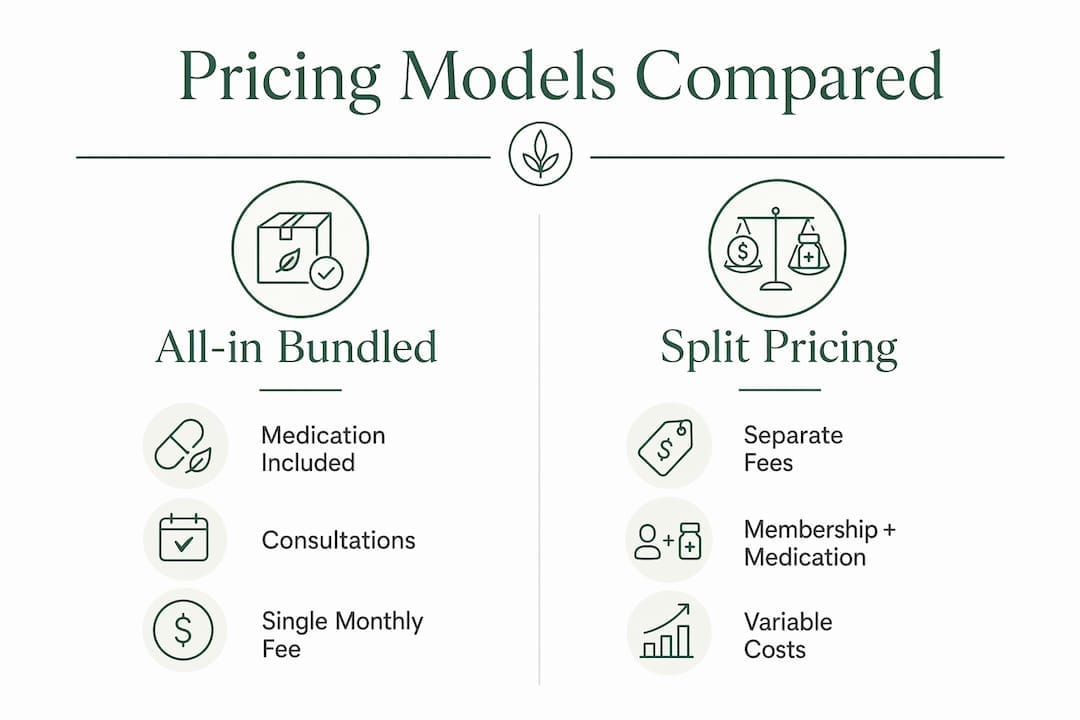
Two pricing models define the online GLP-1 weight loss clinic market as of 2026: all-in bundled pricing and split pricing. Each model has distinct implications for cost predictability and transparency.
| Feature | All-in bundled pricing | Split pricing |
|---|---|---|
| What is included | Medication, consultations, support | Membership only; medication billed separately |
| Typical monthly range | $299–$599 | $99–$199 membership + medication cost |
| Price predictability | High | Low |
| Insurance compatibility | Low | Higher |
| Transparency risk | Lower | Higher |
All-in bundled pricing covers medication, provider consultations, and clinical support in a single monthly charge. This model is easier to budget and less likely to generate surprise invoices. The tradeoff is that bundled programs are typically cash-pay only and do not integrate with insurance billing.
Split pricing separates the membership or platform fee from the medication cost. This structure can appear cheaper at first glance because the membership fee alone looks affordable. The medication cost is billed separately and often escalates with dose increases. Split pricing is more compatible with insurance reimbursement, but it requires patients to track two or more invoices and verify what each covers.
Pro Tip: If you are uninsured or prefer cash-pay simplicity, all-in bundled pricing is the more predictable option. If you have commercial insurance that covers GLP-1 medications, split pricing may reduce your net cost, but verify coverage before enrolling.
Subscription models carry an additional risk: some programs continue charging membership fees even when patients are between doses, waiting on insurance decisions, or experiencing shipping delays. Confirm the cancellation and pause policy before committing to any subscription-based program.
How can patients identify and avoid hidden fees?
Hidden fees in online weight loss programs follow predictable patterns. Knowing what to look for before you enroll protects your budget and prevents frustration.
- Request the maintenance-dose price in writing. The advertised price reflects the starter dose. Ask specifically what the monthly cost will be at 1 mg semaglutide or the equivalent maintenance dose for tirzepatide.
- Confirm the lab work policy. Lab fees range from $0 to $500 depending on whether the provider accepts recent external bloodwork. If the clinic requires its own proprietary lab, factor that cost into your first-month budget.
- Ask about shipping charges. Shipping fees of $15–$25 per shipment are common and are frequently excluded from advertised prices. Ask whether shipping is included or billed separately.
- Check dose escalation pricing. Some programs charge a flat monthly rate regardless of dose. Others charge more as your dose increases. Ask for a dose-by-dose price schedule.
- Review add-on policies. Supplements, coaching, and behavioral programs are often presented as optional but may be required for continued enrollment. Confirm which services are truly optional.
- Read the cancellation terms. Some programs require 30 or 60 days notice to cancel. Others charge a cancellation fee. Know the exit terms before you sign up.
Strategies to lower your monthly expenses include choosing programs that accept external lab results, selecting all-in pricing if you are uninsured, and reviewing ways to reduce medication costs through compounded alternatives prescribed by licensed providers.
How does insurance affect the total cost of GLP-1 weight loss treatment?
Insurance coverage for GLP-1 weight loss medications is inconsistent and varies by plan, employer, and state. Understanding what your plan covers before enrolling in any program prevents costly surprises.
Key facts about insurance and GLP-1 pricing in 2026:
- Branded GLP-1 medications without insurance cost $1,349/month for Wegovy. With commercial insurance, out-of-pocket costs typically fall to $75–$300/month.
- Medicare Part D began covering weight loss medications in January 2026, expanding access for patients 65 and older.
- Commercial insurance copays for covered GLP-1 medications range from $25 to $200/month depending on the plan tier and formulary placement.
- Compounded medications are not covered by insurance. Compounded semaglutide and compounded tirzepatide are not FDA-approved drug products, and insurance plans do not reimburse for them. Patients who choose compounded options pay entirely out of pocket.
- Split pricing programs are more likely to work with insurance billing for the medication component, but the membership fee is almost never reimbursable.
- Prior authorization is required by most insurers for branded GLP-1 medications. This process can take weeks and may be denied based on BMI thresholds or comorbidity requirements.
Verifying your insurance coverage before enrolling in any program is the single most effective way to avoid unexpected costs. Call your insurer directly and ask whether your specific medication is on the formulary and what prior authorization criteria apply.
Why pricing transparency is the real issue in telehealth weight loss
The pricing complexity in online weight loss clinics is not accidental. As the Ozari Health Editorial Team, we have reviewed how programs across the telehealth market structure their fees, and the pattern is consistent: 57% of major GLP-1 telehealth companies did not fully disclose total maintenance costs upfront as of April 2026. That number reflects a deliberate choice, not an oversight.
The clinical concern here is real. Patients who enroll based on an advertised price and then face a 60% cost increase at month three are more likely to discontinue treatment. Discontinuation before reaching a therapeutic maintenance dose means the patient absorbs the cost of titration without the full clinical benefit. That is a poor outcome for the patient and a credibility problem for the industry.
A transparent program publishes its full maintenance-dose pricing separately from introductory rates and itemizes every fee before the patient submits personal information. This is not a high bar. It is the minimum standard for ethical telehealth practice.
Patients deserve to know the real monthly cost of their treatment before they commit. The programs that make this information easy to find are the ones worth trusting.
— Ozari Health Editorial Team
Ozari Health's approach to GLP-1 pricing
Ozari Health publishes all-in pricing with no hidden membership fees, no dose escalation surcharges, and no surprise lab charges. Compounded semaglutide is $86/mo on Ozari One, billed $258 every 3 months, and compounded tirzepatide is $125/mo on Ozari One, billed $375 every 3 months, both prescribed by board-certified physicians and fulfilled through licensed US compounding pharmacies. Ozari One ships to every state except California; California patients use Ozari Select, $145/mo billed quarterly for semaglutide or $199/mo for tirzepatide.
Every patient receives ongoing clinical support for dosing, side effects, and refills. No insurance is required. Ozari Health holds LegitScript certification and publishes named pharmacy partners so patients know exactly where their medication comes from. For patients comparing GLP-1 telehealth options on cost and safety, Ozari Health's compounded semaglutide program offers a straightforward, fully disclosed pricing structure available in all 50 states.
Medical disclaimer: This article is for informational purposes only and does not constitute medical advice. Consult a licensed healthcare provider before starting any weight loss medication. Reviewed by Dr. Michael Wasef, MD, Board-Certified Internal Medicine, Florida License ME125730.
Key takeaways
Transparent, maintenance-dose pricing is the only reliable basis for comparing online weight loss clinic fees, because advertised starter-dose prices routinely understate real monthly costs by $100–$200 or more.
| Point | Details |
|---|---|
| Advertised vs. real cost | Median maintenance-dose price is 1.63 times the advertised introductory rate. |
| Two dominant pricing models | All-in bundled pricing ($299–$599) offers predictability; split pricing separates membership from medication costs. |
| Hidden fees to verify | Lab work, shipping, dose escalation surcharges, and add-ons can add $50–$500 to monthly costs. |
| Insurance limitations | Compounded GLP-1 medications are not covered by insurance; branded options require prior authorization. |
| Transparency standard | Programs that publish full maintenance-dose pricing upfront are the most trustworthy option. |
Perspective: Why the industry's pricing habits harm patients
The pricing complexity in online weight loss clinics is not accidental. As the Ozari Health Editorial Team, we have reviewed how programs across the telehealth market structure their fees, and the pattern is consistent: 57% of major GLP-1 telehealth companies did not fully disclose total maintenance costs upfront as of April 2026. That number reflects a deliberate choice, not an oversight.
The clinical concern here is real. Patients who enroll based on an advertised price and then face a 60% cost increase at month three are more likely to discontinue treatment. Discontinuation before reaching a therapeutic maintenance dose means the patient absorbs the cost of titration without the full clinical benefit. That is a poor outcome for the patient and a credibility problem for the industry.
A transparent weight loss program publishes its full maintenance-dose pricing separately from introductory rates and itemizes every fee before the patient submits personal information. This is not a high bar. It is the minimum standard for ethical telehealth practice.
Patients deserve to know the real monthly cost of their treatment before they commit. The programs that make this information easy to find are the ones worth trusting.
— Ozari Health Editorial Team
FAQ
What is the average cost of an online weight loss clinic per month?
The real monthly cost of online weight loss programs ranges from $299 to $599 for all-in bundled programs, or $200 to $400 when combining split-pricing membership and medication fees. Advertised prices are typically lower because they reflect starter doses, not maintenance doses.
Are there hidden fees in online weight loss programs?
Yes. Common hidden fees include lab work ($0–$500), shipping ($15–$25 per order), dose escalation surcharges, and optional add-ons like supplements or coaching. Asking for a written maintenance-dose fee schedule before enrolling is the most effective way to avoid surprises.
Does insurance cover online GLP-1 weight loss programs?
Commercial insurance may cover branded GLP-1 medications with copays of $25–$200/month, and Medicare Part D began covering weight loss medications in January 2026. Compounded semaglutide and compounded tirzepatide are not covered by insurance and are paid out of pocket.
What is the difference between all-in pricing and split pricing?
All-in pricing bundles medication, consultations, and support into one monthly charge ($299–$599). Split pricing charges a separate membership fee ($99–$199) plus the medication cost billed separately. All-in pricing is more predictable; split pricing may work better for patients with insurance coverage for branded medications.
How can I find an affordable online weight loss clinic?
Choose programs that publish full maintenance-dose pricing upfront, accept external lab results, and include shipping in their stated price. Compounded GLP-1 options through LegitScript-certified telehealth providers, such as Ozari Health, offer lower costs than branded medications without requiring insurance. Review the GLP-1 medication FAQ for detailed cost comparisons.
Sources
Related Articles
Men: Fella Health Safety Risks, Real Costs, and an $86 Alternative
A safety-first look at Fella Health for men: why compounded GLP-1s show higher FDA reporting risks, how to calculate all-in monthly cost, and an $86 Ozari...
Read more →generalHallandale Semaglutide vs Tirzepatide: What Patients Should Know
Compare the compounded semaglutide and tirzepatide formulations Hallandale currently lists, including concentrations, regulatory status, dosing differences, and Ozari fulfillment.
Read more →generalHallandale Pharmacy Shipping: Delivery, Packaging & Storage Guide
How Hallandale Pharmacy fulfillment works, what to check when a GLP-1 shipment arrives, storage guidance, delays, and Ozari order support.
Read more →