Tirzepatide Pancreatitis Risk: What You Need to Know
Published July 27, 2026

TL;DR:
- Tirzepatide does not significantly increase the risk of clinically confirmed acute pancreatitis according to pooled trial data. However, rare severe cases occur mainly in patients with pre-existing risk factors like gallstones or high triglycerides, requiring careful monitoring. Patients should watch for persistent severe abdominal pain and consult their clinician promptly if symptoms suggest pancreatitis.
Current randomized trial data and pooled meta-analyses do not show a statistically significant increase in clinically confirmed acute pancreatitis with tirzepatide compared to placebo, insulin, or other GLP-1 receptor agonists. A meta-analysis of 17 RCTs covering 14,645 participants found pooled pancreatitis proportions of approximately 0.3–0.4%, with no meaningful difference between tirzepatide and comparator groups. Pancreatic enzyme elevations (lipase and amylase) are more common than clinical pancreatitis and do not, on their own, confirm disease.
That said, rare severe events have been reported in post-marketing surveillance, and certain patients carry a meaningful higher baseline risk. The practical takeaway is not that pancreatitis is impossible, but that it is rare, often linked to pre-existing risk factors, and manageable with the right monitoring approach.
Three things to do right now:
- Monitor for severe, persistent abdominal pain that radiates to the back. This is not a typical tirzepatide side effect and warrants urgent evaluation.
- Tell your clinician about any history of pancreatitis, gallstones, high triglycerides, or heavy alcohol use before starting or continuing tirzepatide.
- Go to the emergency department if you develop severe epigastric pain with vomiting or fever. Do not wait to see if it resolves.
Table of Contents
- Does tirzepatide actually increase pancreatitis risk? What the trials show
- What published case reports and post-marketing data reveal
- Why tirzepatide raises enzymes without necessarily causing pancreatitis
- How to tell common GI side effects from possible pancreatitis
- Who has higher baseline pancreatitis risk and needs extra caution
- Practical monitoring and management for patients and clinicians
- How common is pancreatitis on tirzepatide compared to background rates?
- What to bring and the right questions to ask your clinician
- Short verdict and clear next steps
- Key Takeaways
- A clinician's perspective on prescribing tirzepatide safely
- Supervised tirzepatide access through Ozari Health
- Primary sources and further reading
- FAQ
Does tirzepatide actually increase pancreatitis risk? What the trials show
The most rigorous available evidence comes from systematic reviews and meta-analyses pooling data across multiple randomized controlled trials. A dose-response meta-analysis of 19 RCTs involving over fifteen thousand participants found acute pancreatitis to be very rare, with no statistically significant difference across tirzepatide doses of 5 mg, 10 mg, and 15 mg. Head-to-head dose comparisons showed no significant differences in risk.
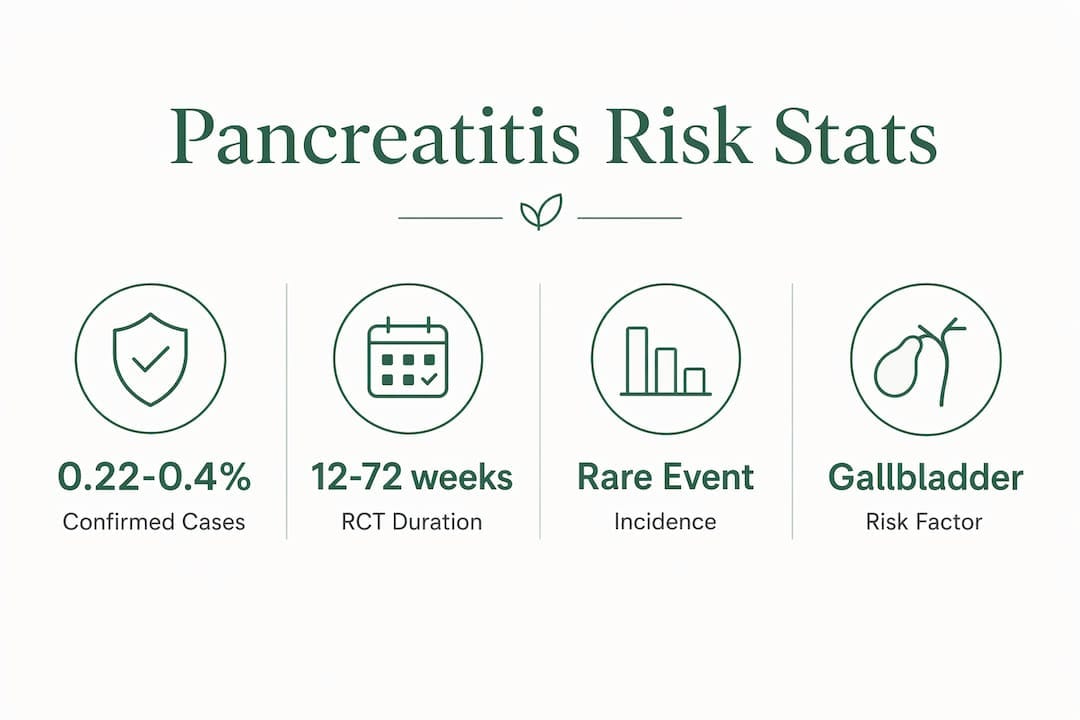
A separate meta-analysis of nine RCTs with nearly ten thousand participants reached a consistent conclusion: tirzepatide was not significantly associated with increased pancreatitis risk compared to placebo, basal insulin, or GLP-1 receptor agonists. Importantly, that same analysis found tirzepatide was associated with a higher composite risk of gallbladder or biliary disease, which matters because gallstone-related pancreatitis is an indirect pathway worth monitoring.
One consistent pattern across trials is that lipase and amylase elevations occur more frequently than adjudicated clinical pancreatitis. Elevated enzymes alone do not meet the diagnostic threshold for acute pancreatitis, which typically requires at least two of three criteria: characteristic abdominal pain, enzyme levels three times the upper limit of normal, and confirmatory imaging.
The evidence has real limits. Most RCTs ran for 12–72 weeks, which is a relatively short window for detecting rare events. Trials also routinely excluded patients with a prior history of pancreatitis, so the safety profile in that subgroup is not well established from trial data alone. Real-world pharmacovigilance data fills some of that gap, though with its own limitations around causation.
What published case reports and post-marketing data reveal
Post-marketing surveillance adds important context that trial data cannot fully capture. The UK Medicines and Healthcare products Regulatory Agency (MHRA) issued a strengthened safety warning for GLP-1 and dual GLP-1/GIP receptor agonists, noting 1,296 Yellow Card reports of pancreatitis associated with these agents from 2007 through October 2025, including 19 fatal reports. Regulators updated product information accordingly to highlight the potential for severe acute pancreatitis, including rare necrotizing and fatal cases.
A one-year audit at a UK district general hospital found four tirzepatide users among 222 pancreatitis admissions, representing 1.8% of that cohort. Three of the four had clear alternative causes such as gallstones or alcohol use. None developed necrosis or required ICU care.
Published case reports span a severity spectrum from mild, self-limiting acute pancreatitis to rare necrotizing presentations. Several key observations emerge from reviewing these reports:
- Most cases involve at least one traditional pancreatitis trigger (gallstones, hypertriglyceridemia, alcohol use) alongside tirzepatide use.
- Temporal association between starting tirzepatide and symptom onset is documented, but temporal association does not establish causation.
- Necrotizing pancreatitis cases are rare and almost always accompanied by significant confounding factors.
- The MHRA data covers the entire class of GLP-1 and dual GLP-1/GIP agonists, not tirzepatide alone, which means the 19 fatal reports span multiple medications over nearly two decades.
The honest read of post-marketing data is that severe pancreatitis can occur in patients taking tirzepatide, but the available evidence consistently points to pre-existing risk factors as the primary drivers rather than the drug itself.
Why tirzepatide raises enzymes without necessarily causing pancreatitis
Tirzepatide activates both GIP and GLP-1 receptors, and incretin agonism has a known association with elevated amylase and lipase levels. The precise mechanism is not fully established, but GLP-1 receptors are expressed in pancreatic acinar cells, and receptor stimulation may increase enzyme secretion without triggering the inflammatory cascade that defines clinical pancreatitis.

The more clinically significant pathway is indirect. Rapid weight loss, which tirzepatide can produce, causes gallbladder hypomotility and biliary sludge. That process can accelerate gallstone formation, and gallstone pancreatitis is one of the most common causes of acute pancreatitis in the general population. A Cleveland Clinic review noted that multiple meta-analyses of GLP-1 receptor agonists show a neutral relationship with acute pancreatitis, with some investigators concluding that weight loss itself may better explain any pancreatitis signal than incretin therapy directly. A large network meta-analysis of 102,257 participants cited in that review found a neutral RR of 0.96 (95% CI 0.31–3.00) for GLP-1 agents versus comparators.
The biliary risk is particularly relevant in the first 60 days of treatment, when weight loss tends to be most rapid. Clinicians watch for right upper quadrant discomfort, pale stools, or persistent nausea as early biliary warning signs during this window.
Patients who lose weight quickly through GLP-1 therapy or bariatric surgery face similar gallbladder dynamics, which is why monitoring approaches in both populations overlap.
Pro Tip: When a patient on tirzepatide has elevated lipase without abdominal pain, most clinicians do not diagnose pancreatitis. The clinical standard requires at least two of three criteria: characteristic pain, enzyme elevation to three times the upper limit of normal, and confirmatory imaging. Enzyme elevation alone is not sufficient.
How to tell common GI side effects from possible pancreatitis
Tirzepatide's most common side effects are gastrointestinal: nausea, vomiting, diarrhea, and early satiety. These typically appear during dose escalation, tend to be mild to moderate, and resolve within days to a few weeks as the body adjusts. They are not signs of pancreatitis.

Pancreatitis presents differently. The hallmark symptom is severe, persistent epigastric pain that radiates to the back, does not resolve with position changes, and worsens over hours rather than improving. Associated symptoms include persistent vomiting that does not subside, fever, and a rigid or tender abdomen. This is not the transient queasiness that follows a tirzepatide injection.
Symptoms that require urgent evaluation:
- Severe pain in the upper abdomen or mid-abdomen that persists for more than a few hours
- Pain that radiates through to the back
- Pain that worsens with movement or eating
- Persistent vomiting that does not improve after several hours
- Fever accompanying abdominal pain
- Abdominal tenderness or rigidity on touch
If you experience these symptoms, stop taking tirzepatide and seek care immediately. Call your clinician if symptoms are moderate and developing. Go directly to the emergency department if pain is severe, you cannot keep fluids down, or you have a fever. Do not self-manage severe abdominal pain at home.
Pro Tip: When evaluating a patient on tirzepatide for possible pancreatitis, clinicians typically order a serum lipase (more sensitive than amylase) and, if biliary cause is suspected, a right upper quadrant ultrasound. CT imaging is reserved for cases where severity assessment or complications need to be evaluated.
For a broader overview of what to expect on this medication, the tirzepatide side effects guide at Ozari Health covers the full spectrum of common and less common adverse events.
Who has higher baseline pancreatitis risk and needs extra caution
Not everyone faces the same level of risk. Several comorbidities and clinical situations raise baseline pancreatitis risk enough to warrant individualized decision-making before and during tirzepatide use.
Primary risk factors to discuss with your clinician:
- Prior history of pancreatitis: Trials excluded patients with a history of pancreatitis, so safety data in this group is limited. Clinical reviews recommend individualized decision-making rather than a blanket contraindication, with closer monitoring if tirzepatide is used.
- Known gallstones or biliary disease: Gallstone pancreatitis is the most common cause of acute pancreatitis in the U.S. Patients with existing gallstones face compounded risk if tirzepatide accelerates biliary changes.
- Severe hypertriglyceridemia: Triglycerides above 1,000 mg/dL are an independent cause of pancreatitis. Tirzepatide can lower triglycerides, but patients with very high baseline levels need monitoring before and during treatment.
- Heavy alcohol use: Alcohol is one of the two leading causes of acute pancreatitis. Concurrent use with tirzepatide raises overall risk substantially.
Contextual risks tied specifically to tirzepatide use include the biliary changes associated with rapid early weight loss. Patients who lose weight quickly are at higher risk for gallstone formation, and that risk peaks in the first few months of treatment. Some clinicians consider short-term ursodeoxycholic acid (UDCA) prophylaxis for selected high-risk patients during rapid weight-loss phases, drawing on analogies from bariatric surgery literature where this approach has clinical support. The patient education resources at Weight Loss Surgery Guide offer useful context on biliary risk during rapid weight loss for patients who want to understand this mechanism further.
Patients with metabolic syndrome, obesity-related fatty liver disease, or a family history of gallbladder disease also warrant a more thorough baseline assessment before starting tirzepatide.
Practical monitoring and management for patients and clinicians
A structured approach before and during tirzepatide treatment reduces the chance that a pancreatitis event goes undetected or is misattributed to routine side effects.
Before starting tirzepatide:
- Review personal and family history of pancreatitis, gallstones, and biliary disease.
- Check fasting triglycerides. Severe hypertriglyceridemia should be addressed before initiating therapy.
- Obtain a baseline lipase measurement if the patient has a history of pancreatic disease or elevated risk.
- Document alcohol use history and counsel on reduction if applicable.
- Discuss the biliary risk of rapid weight loss and what symptoms to watch for in the first 60 days.
During treatment:
- Reassess symptoms at each follow-up visit, particularly during dose escalation when GI side effects are most common.
- Check lipase if the patient reports persistent or severe abdominal pain. Do not rely on symptom description alone.
- Order right upper quadrant ultrasound if biliary symptoms develop (right upper quadrant pain, pale stools, jaundice).
- For patients losing weight rapidly, consider whether UDCA prophylaxis is appropriate. This is not standard practice for all patients, but some clinicians apply it selectively for those with pre-existing biliary risk.
Stop/pause rules: Discontinue tirzepatide and seek evaluation for any episode of confirmed or suspected acute pancreatitis. Do not restart without specialist guidance. For patients with severe persistent abdominal pain that has not been evaluated, hold the next dose until a clinical assessment is completed.
Pro Tip: Slow, gradual dose titration reduces the intensity of GI side effects and may reduce the rate of early weight loss, which in turn lowers the biliary risk window. Patients who tolerate a slower titration schedule often report fewer GI complaints overall. The tirzepatide dosing guide at Ozari Health outlines titration schedules that support this approach.
How common is pancreatitis on tirzepatide compared to background rates?
Putting the numbers in context matters. Acute pancreatitis affects roughly 13–45 per 100,000 people annually in the general U.S. population, with gallstones and alcohol accounting for the majority of cases. Against that background, the trial-level incidence with tirzepatide is low.
| Source | Population | Pancreatitis Observations | Notes |
|---|---|---|---|
| Dose-response meta-analysis, 19 RCTs | Over fifteen thousand participants | Acute pancreatitis was very rare, with no dose-response relationship detected | All doses showed no significant difference versus comparators |
| Meta-analysis of 17 RCTs | 14,645 participants | Pooled pancreatitis events were uncommon and similar between groups | No increased risk versus placebo, insulin, and GLP-1 RAs |
| Nine-RCT meta-analysis | — | No significant elevation in pancreatitis risk observed | Statistical tests indicated no significant association |
| UK single-center audit | 222 pancreatitis admissions | Tirzepatide users were identified but represented a small fraction | Most cases had alternative pancreatitis causes documented |
The UK audit figure indicates a small portion of pancreatitis admissions involved tirzepatide users; it does not imply that a similar percentage of tirzepatide patients develop pancreatitis. The trial-level evidence consistently places pancreatitis incidence below half a percent.
What the data collectively suggest is that when pancreatitis does occur in a tirzepatide user, it is usually driven by pre-existing risk factors rather than the medication itself. The gallbladder and biliary disease signal is the more clinically actionable finding from the trial data, given the statistically significant elevated composite risk seen in one meta-analysis.
What to bring and the right questions to ask your clinician
A productive conversation with your prescribing clinician about pancreatitis risk requires preparation. Arriving with the right information and specific questions leads to better individualized guidance.
Documents and history to bring:
- Recent lab results, including fasting triglycerides and any prior lipase or amylase measurements
- Imaging history, particularly any abdominal ultrasound results showing gallstones or biliary changes
- Documentation of any prior pancreatitis episodes, including dates, severity, and cause if known
- A clear account of alcohol use, including frequency and quantity
- A list of all current medications, including supplements that may affect triglycerides
Questions to ask your clinician:
- Based on my history, what is my baseline pancreatitis risk before starting tirzepatide?
- Should I have a lipase or triglyceride check before beginning treatment?
- What symptoms should prompt me to call your office versus go directly to the emergency department?
- Given my history, would you recommend UDCA prophylaxis during the early weight-loss phase?
- If I have a prior history of pancreatitis, is tirzepatide still an option for me, and what monitoring would you recommend?
- Are there alternative GLP-1 therapies that might carry a different risk profile for my situation?
How to describe symptoms clearly: If you contact your clinician about abdominal pain, note the location (upper abdomen, mid-abdomen, or right side), whether it radiates to the back, how long it has lasted, whether it is constant or comes in waves, and whether eating makes it better or worse. That level of detail helps clinicians triage appropriately.
Short verdict and clear next steps
Tirzepatide, available as Mounjaro for type 2 diabetes and Zepbound for weight management (both from Eli Lilly), does not carry a demonstrated statistically significant increase in clinically confirmed acute pancreatitis based on pooled RCT data. The risk is rare, and when pancreatitis does occur in patients taking tirzepatide, traditional triggers such as gallstones, alcohol, and hypertriglyceridemia are usually present.
For routine GI side effects (nausea, vomiting, early satiety):
- These are expected, particularly during dose escalation, and typically resolve within days to weeks.
- Continue tirzepatide as prescribed and discuss dose adjustment with your clinician if side effects are persistent.
- Stay hydrated and eat smaller, lower-fat meals to reduce GI discomfort.
For persistent or severe abdominal pain:
- Hold your next tirzepatide dose.
- Contact your clinician promptly for evaluation, including a lipase measurement.
- If pain is severe, accompanied by vomiting, or you have a fever, do not wait for a clinic appointment.
Emergency criteria — call 911 or go to the ED immediately if you have:
- Severe upper abdominal pain that does not improve within a few hours
- Pain radiating to the back with persistent vomiting
- Fever above 101°F with abdominal pain
- Signs of shock: rapid heart rate, dizziness, or fainting alongside abdominal pain
- Inability to keep any fluids down for more than 6 hours
Key Takeaways
Pooled randomized trial data consistently show no statistically significant increase in clinically confirmed acute pancreatitis with tirzepatide, though rare severe events occur and pre-existing risk factors drive most reported cases.
| Point | Details |
|---|---|
| Trial data verdict | Pooled meta-analyses across thousands of participants show tirzepatide pancreatitis incidence at approximately 0.3–0.4%, with no significant difference vs. comparators. |
| Enzyme elevation vs. disease | Elevated lipase or amylase alone does not confirm pancreatitis; clinical diagnosis requires pain, enzyme elevation, and/or confirmatory imaging. |
| Biliary risk is real | Tirzepatide is associated with a significantly higher composite risk of gallbladder and biliary disease, which can indirectly cause pancreatitis. |
| Know your risk factors | Prior pancreatitis, gallstones, severe hypertriglyceridemia, and heavy alcohol use all raise baseline risk and require individualized clinical assessment. |
| Ozari Health monitoring | Ozari Health's supervised tirzepatide pathway includes baseline screening and ongoing clinical support to help identify and manage pancreatitis risk factors. |
A clinician's perspective on prescribing tirzepatide safely
The pancreatitis question comes up in nearly every tirzepatide consultation, and the honest answer is more nuanced than either "it's completely safe" or "it's dangerous." The trial data is reassuring. Across tens of thousands of participants, the incidence of confirmed pancreatitis is low and statistically indistinguishable from placebo. That is meaningful.
What the trials cannot tell us is how a specific patient with gallstones, a prior mild pancreatitis episode, and triglycerides trending upward will respond over 18 months of treatment. That is where clinical judgment matters more than pooled statistics. Before prescribing, a thorough history of biliary disease, prior pancreatic events, and metabolic risk factors shapes the monitoring plan. For patients with multiple risk factors, the first 60 days of treatment deserve closer attention because that is when weight loss is fastest and biliary changes are most likely.
The gallbladder signal in the meta-analysis data is the finding that deserves more attention in clinical practice. Tirzepatide is not clearly causing pancreatitis directly, but it may be accelerating gallstone formation in susceptible patients, and gallstone pancreatitis is entirely preventable with the right monitoring. Patients who develop right upper quadrant discomfort, pale stools, or jaundice during treatment should be evaluated promptly, not reassured that it is a GI side effect.
The practical approach is straightforward: screen carefully, titrate slowly, monitor biliary symptoms in the first few months, and have a clear plan for what to do if abdominal pain develops. Tirzepatide's benefits for metabolic health are substantial. Managing the pancreatitis risk well means most patients can access those benefits safely.
Supervised tirzepatide access through Ozari Health
For patients who want to start tirzepatide with clinical oversight built into the process, Ozari Health offers a fully online prescribing pathway available in all 50 states. The service connects cash-pay patients with licensed providers who conduct a baseline eligibility review before prescribing, including a review of pancreatitis risk factors, gallbladder history, and triglyceride levels where clinically indicated.
Compounded tirzepatide through Ozari Health is $125/mo on Ozari One, billed $375 every 3 months, fulfilled through licensed U.S. compounding pharmacies with direct delivery. Ozari One ships to every state except California; California patients use Ozari Select, $199/mo billed quarterly for tirzepatide. Ongoing clinical support covers dosing adjustments, side effect management, and symptom triage throughout treatment. The platform is LegitScript certified, with transparent all-in pricing and no hidden membership fees.
Medical oversight is provided by licensed clinicians, with Dr. Michael Wasef, MD (Board-Certified Internal Medicine, Florida License ME125730) serving as medical reviewer. Compounded tirzepatide is not FDA-approved as a branded product and is not a generic version of Mounjaro or Zepbound. No guaranteed weight-loss outcomes are implied or promised.
Patients who want to review their eligibility and understand how pancreatitis risk factors are assessed before prescribing can start with Ozari's tirzepatide service or explore compounded tirzepatide availability by state.
This article is for general informational purposes only and does not constitute medical advice. Consult a qualified healthcare provider to evaluate your individual risk and determine whether tirzepatide is appropriate for your situation.
Sources
The following sources represent the highest-quality evidence available on tirzepatide and pancreatitis risk. Patients and clinicians are encouraged to review these directly and discuss findings with a qualified provider.
- Dose-response meta-analysis of tirzepatide and acute pancreatitis (PubMed, 2025): Nineteen RCTs, 15,471 participants; no dose-response relationship across 5–15 mg doses; acute pancreatitis rate 0.22%.
- Pancreatic safety of tirzepatide: systematic review and meta-analysis (PubMed/PMC): Seventeen RCTs, 14,645 subjects; identical pancreatitis risk vs. placebo, insulin, and GLP-1 RAs; pooled proportions ~0.3–0.4%.
- Tirzepatide safety for pancreatitis and biliary disease: meta-analysis (PMC): Nine RCTs, 9,871 participants; pancreatitis risk non-significant; biliary disease composite risk significantly elevated.
- UK single-center pancreatitis audit (PMC): Real-world audit of 222 pancreatitis admissions; 4 tirzepatide users identified; most had alternative causes.
- MHRA safety update on GLP-1/dual GLP-1/GIP agonists and pancreatitis (Gov.UK): Regulatory strengthening of pancreatitis warnings; 1,296 Yellow Card reports across the class through October 2025.
- GLP-1 receptor agonists and pancreatitis: Cleveland Clinic Journal of Medicine review: Neutral relationship across large network meta-analyses; weight loss as a potential explanatory factor.
- Reconciling GLP-1s and pancreatitis: Cleveland Clinic consultQD: Clinical guidance on individualized prescribing for patients with prior pancreatitis and UDCA prophylaxis considerations.
FAQ
How likely is it to get pancreatitis from tirzepatide?
Across pooled randomized trial data, confirmed acute pancreatitis occurred in approximately 0.22–0.4% of tirzepatide-treated participants, with no statistically significant difference compared to placebo or other diabetes medications. The absolute risk is low, though patients with gallstones, high triglycerides, or a prior pancreatitis history carry a higher baseline risk.
What percentage of people get pancreatitis on Mounjaro?
In the largest available meta-analyses of Mounjaro (tirzepatide) trials, the pooled pancreatitis incidence was approximately 0.3–0.4%, with risk ratios showing no significant increase versus comparators. These figures come from controlled trial populations and may not fully reflect real-world use in patients with multiple risk factors.
How do you avoid pancreatitis on Zepbound or other GLP-1 medications?
The most effective steps are managing modifiable risk factors: address high triglycerides before starting treatment, avoid heavy alcohol use, and report any gallbladder symptoms promptly. Slow dose titration reduces the pace of early weight loss, which lowers the risk of biliary sludge and gallstone formation during the highest-risk window.
What symptoms should make you stop tirzepatide immediately?
Severe, persistent upper abdominal pain radiating to the back, especially with vomiting or fever, warrants stopping tirzepatide and seeking emergency evaluation. Routine nausea and mild GI discomfort during dose escalation do not require stopping the medication, but any pain that is severe, constant, or worsening over hours should be evaluated without delay.
Who should not take tirzepatide due to pancreatitis risk?
Tirzepatide is not absolutely contraindicated in patients with a prior history of pancreatitis, but clinical reviews recommend individualized assessment because trials excluded this group. Patients with active pancreatitis, uncontrolled severe hypertriglyceridemia, or multiple compounding risk factors should discuss the benefit-risk balance carefully with their clinician before starting treatment.
Related Articles
Men: Fella Health Safety Risks, Real Costs, and an $86 Alternative
A safety-first look at Fella Health for men: why compounded GLP-1s show higher FDA reporting risks, how to calculate all-in monthly cost, and an $86 Ozari...
Read more →generalHallandale Semaglutide vs Tirzepatide: What Patients Should Know
Compare the compounded semaglutide and tirzepatide formulations Hallandale currently lists, including concentrations, regulatory status, dosing differences, and Ozari fulfillment.
Read more →generalHallandale Pharmacy Shipping: Delivery, Packaging & Storage Guide
How Hallandale Pharmacy fulfillment works, what to check when a GLP-1 shipment arrives, storage guidance, delays, and Ozari order support.
Read more →