The Role of Gut Hormone GLP-1 in Weight Loss
Published July 6, 2026

TL;DR:
- GLP-1 is a gut hormone that signals fullness and slows digestion to promote weight loss. Its receptor agonists produce sustained appetite suppression, leading to significant and consistent long-term weight reduction.
GLP-1, or glucagon-like peptide-1, is defined as an intestinal hormone that signals fullness to the brain and slows digestion to reduce calorie intake. Its role in gut hormone GLP-1 weight regulation has moved from basic science to front-line obesity medicine in under a decade. The NIH and FDA now recognize GLP-1 receptor agonists as a legitimate pharmacologic treatment for chronic obesity, not just type 2 diabetes. Ozari Health connects patients with licensed providers who prescribe compounded GLP-1 medications, making this science clinically accessible at transparent pricing.
How does GLP-1 affect appetite and digestion to influence weight?
GLP-1 is secreted by L-cells in the small intestine and colon within minutes of eating. It does three things simultaneously: it triggers insulin release from the pancreas, sends satiety signals to the hypothalamus, and slows gastric emptying to extend the feeling of fullness after a meal. Each mechanism independently reduces calorie intake. Together, they create a sustained suppression of hunger that most patients have never experienced through diet alone.

The brain component is often underappreciated. GLP-1 receptors sit in the hypothalamus and brainstem, areas that govern hunger, reward, and food-seeking behavior. When GLP-1 activates these receptors, it quiets what clinicians call "food noise," the persistent mental preoccupation with eating that drives overconsumption. Patients on GLP-1 therapy frequently report that food simply stops occupying their thoughts between meals.
Gastric emptying is equally important. When food leaves the stomach more slowly, blood sugar rises gradually rather than spiking. That gradual rise sustains satiety longer and reduces the sharp hunger rebound that follows a rapid glucose peak. The net result is smaller meal sizes, longer intervals between meals, and a meaningful reduction in total daily calorie intake.
- GLP-1 stimulates insulin secretion in a glucose-dependent manner, reducing the risk of hypoglycemia
- Satiety signals reach the brain within 15–30 minutes of eating
- Slower gastric emptying reduces post-meal hunger rebounds
- Reduced food noise lowers impulsive eating and calorie-dense food cravings
- Longer satiety periods decrease meal frequency without requiring willpower
Pro Tip: If you are starting GLP-1 therapy, eat slowly and stop at the first sign of fullness. The hormone is already working before your plate is empty, and eating past satiety is the most common cause of nausea in early treatment.
What evidence supports GLP-1 receptor agonists for weight loss?
The clinical evidence for GLP-1 receptor agonists is among the strongest in obesity medicine. A meta-analysis of over 19,000 patients across 64 clinical trials confirmed that GLP-1 agents produce consistent weight loss across age groups, ethnicities, and BMI categories. That breadth of evidence is unusual in pharmacology and reflects how central GLP-1 pathways are to human weight regulation.
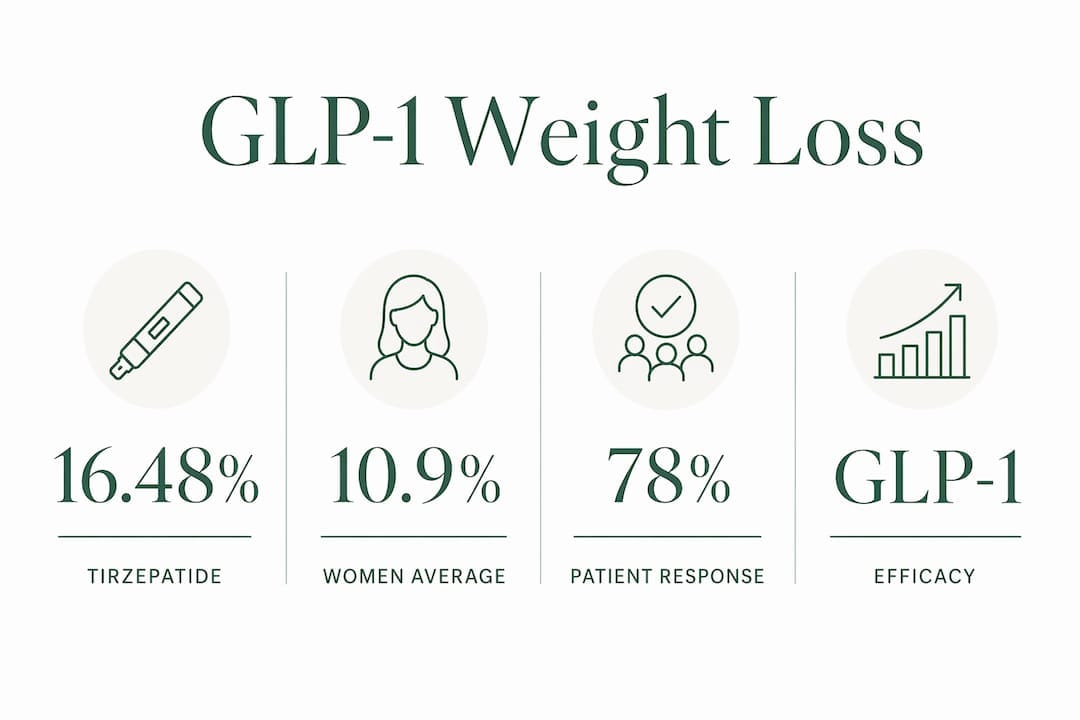
Tirzepatide, a dual GIP/GLP-1 receptor agonist, produced up to 16.48% relative weight loss at 24–52 weeks in non-diabetic patients. That figure represents a level of weight reduction previously associated only with bariatric surgery. Semaglutide, a GLP-1 receptor agonist, produces clinically significant but somewhat lower average losses, making the two agents the current benchmarks in this drug class.
Gender differences in response are real and clinically relevant. Women lose an average of 10.9% of body weight on GLP-1 therapy, compared to 6.8% in men, according to the same large meta-analysis. The mechanism behind this difference is not fully established, but it does not change the clinical recommendation: both groups achieve meaningful, sustained weight loss that exceeds what lifestyle interventions alone typically produce.
| Agent | Mechanism | Average weight loss | Population studied |
|---|---|---|---|
| Semaglutide | GLP-1 receptor agonist | Clinically significant | Diabetic and non-diabetic adults |
| Tirzepatide | Dual GIP/GLP-1 agonist | Up to 16.48% | Non-diabetic adults, 24–52 weeks |
The surge in prescriptions confirms this clinical confidence. GLP-1 prescriptions in non-diabetic patients increased 700% between 2019 and 2023. That growth reflects a fundamental shift in how medicine classifies obesity: as a chronic, biologically driven condition rather than a failure of willpower.
Key safety signals from trials include:
- Nausea and vomiting are the most common adverse effects, particularly at dose initiation
- Gastrointestinal side effects decrease significantly with gradual dose escalation
- Serious adverse events are rare and generally comparable to placebo in large trials
- Patients with a personal or family history of medullary thyroid carcinoma should not use GLP-1 agents
What are the key considerations when using GLP-1 therapies for weight management?
GLP-1 therapy is not a single dose taken once. It requires a structured escalation protocol, ongoing monitoring, and proactive management of side effects and body composition changes. Patients who understand this from the start are far more likely to complete treatment and sustain results.
Managing gastrointestinal side effects
Nausea affects a substantial proportion of patients starting GLP-1 therapy. Gradual dose escalation02105-1) is the primary strategy for managing this, and rushing the titration schedule is the leading cause of premature discontinuation. Most protocols increase the dose every four weeks, allowing the gut to adapt before the next increment. Patients who skip this process and escalate too quickly often experience vomiting severe enough to stop treatment entirely.
Pro Tip: Eating smaller, lower-fat meals during the first four to eight weeks of GLP-1 therapy reduces nausea significantly. High-fat foods slow gastric emptying further, compounding the effect of the medication.
Weight loss plateaus and receptor dynamics
Weight loss plateaus are a recognized feature of GLP-1 therapy, not a treatment failure. NIH research shows that some neurons internalize GLP-1 receptors over time, reducing the hormone's effect on those cells. Researchers are currently investigating PDE4 inhibition as a strategy to prevent receptor internalization and extend the duration of weight loss. This is an active area of research, and patients should expect plateaus as a normal phase of treatment rather than a signal to stop.
Protecting muscle and bone during weight loss
Significant weight loss from any cause, including GLP-1 therapy, carries a risk of lean muscle mass and bone density reduction. Studies confirm that patients losing substantial body weight on GLP-1 medications experience measurable changes in structural health markers. The clinical response is straightforward: adequate protein intake and resistance training are recommended throughout treatment to preserve muscle and bone. This is not optional guidance. It is a standard part of responsible GLP-1 therapy management.
- Aim for at least 1.2 grams of protein per kilogram of body weight daily
- Incorporate resistance training at least two days per week
- Monitor bone density if weight loss exceeds 15% of starting body weight
- Work with a licensed provider to adjust nutrition as dosing increases
How does GLP-1 compare with other weight loss approaches?
GLP-1 therapy sits between lifestyle intervention and bariatric surgery in terms of efficacy. Lifestyle modifications, including caloric restriction and structured exercise, produce meaningful but modest weight loss in most patients. Bariatric surgery remains the most effective single intervention for severe obesity. GLP-1 medications occupy a critical middle ground: they produce surgery-level results in some patients while remaining reversible and non-invasive.
The connection between surgery and GLP-1 is not coincidental. Bariatric surgery enhances endogenous GLP-1 levels as a direct result of anatomical changes to the gut. Part of surgery's weight loss effect is pharmacologic, driven by the same hormone that GLP-1 medications mimic. This shared mechanism explains why both interventions produce similar metabolic improvements beyond weight loss alone.
GLP-1 therapy is a chronic treatment, not a course of medication with a defined endpoint. Patients who stop GLP-1 therapy typically see appetite return and weight regain follow. This is not a flaw in the medication. It reflects the biology of obesity as a condition requiring ongoing management, the same way hypertension requires ongoing antihypertensive therapy. Combining GLP-1 medication with sustainable dietary changes and regular physical activity produces better long-term outcomes than medication alone.
| Approach | Efficacy | Reversibility | Requires ongoing use |
|---|---|---|---|
| Lifestyle intervention | Modest | Fully reversible | Ongoing |
| GLP-1 receptor agonists | High | Fully reversible | Ongoing |
| Bariatric surgery | Highest | Not reversible | Lifelong follow-up |
Key Takeaways
GLP-1 is the most clinically validated gut hormone for weight regulation, and its receptor agonists produce meaningful, sustained weight loss when combined with appropriate lifestyle support and medical supervision.
| Point | Details |
|---|---|
| GLP-1 reduces appetite via two pathways | It signals satiety to the brain and slows gastric emptying, both reducing total calorie intake. |
| Clinical evidence is strong and broad | A meta-analysis of over 19,000 patients confirms consistent weight loss across age, sex, and BMI. |
| Dose escalation is non-negotiable | Rushing titration causes nausea and treatment dropout; gradual increases over weeks are standard protocol. |
| Muscle and bone need active protection | Resistance training and adequate protein intake are required throughout GLP-1 therapy to prevent structural loss. |
| GLP-1 therapy is chronic, not curative | Appetite returns after discontinuation; long-term management and lifestyle integration are necessary for sustained results. |
GLP-1 as a food thermostat: what clinical experience actually shows
The framing of GLP-1 as a "food thermostat" is clinically accurate and practically useful. It captures something that patients often miss: the hormone does not suppress appetite through willpower or sedation. It resets the biological set point at which the body signals hunger. That distinction matters because it explains both the medication's effectiveness and its limitations.
What clinical experience consistently shows is that patients underestimate how much of their eating behavior is driven by neurobiology rather than choice. When GLP-1 therapy quiets food noise, many patients are surprised by how little effort it takes to eat less. That surprise is informative. It tells us that prior weight loss failures were not personal failures. They were the predictable result of fighting a biological signal without pharmacologic support.
The harder conversation is about discontinuation. When GLP-1 therapy stops, the appetite mechanisms return to their pre-treatment state. Weight regain follows in most patients who do not maintain lifestyle changes. GLP-1 is a management tool for a chronic condition, not a cure. Patients who enter therapy with that understanding, and who use the reduced-appetite window to build sustainable habits, achieve the best long-term outcomes. Those who treat it as a temporary fix tend to cycle back to their starting weight. Medical supervision throughout treatment is not a formality. It is the mechanism by which dose adjustments, side effect management, and lifestyle coaching are delivered at the right time.
— Ozari Health Editorial Team
GLP-1 therapy through Ozari Health: transparent access, clinical oversight
Patients who understand GLP-1 biology are better positioned to make informed decisions about treatment. Ozari Health is a fully online GLP-1 telehealth platform serving patients in all 50 states, connecting cash-pay patients with licensed providers who assess eligibility and prescribe compounded medications with no insurance required and no hidden fees.
Compounded semaglutide is $86/mo on Ozari One, billed $258 every 3 months, and compounded tirzepatide is $125/mo on Ozari One, billed $375 every 3 months, fulfilled through licensed US compounding pharmacies and delivered directly to patients. Ozari One ships to every state except California; California patients use Ozari Select, $145/mo billed quarterly for semaglutide or $199/mo for tirzepatide. Compounded medications are not FDA-approved products and are not generic versions of branded drugs. Clinical support from Dr. Michael Wasef, MD, Board-Certified Internal Medicine (Florida License ME125730), covers dosing, side effects, and refills throughout treatment. Patients can review GLP-1 pricing and trial data or explore the full medication FAQ at Ozari Health before making any decisions.
Medical Disclaimer: This article is for informational purposes only and does not constitute medical advice. Consult a licensed healthcare provider before starting any GLP-1 therapy. Individual results vary and no specific weight loss outcome is guaranteed.
FAQ
What is the role of GLP-1 in weight regulation?
GLP-1 is a gut hormone that signals satiety to the brain and slows gastric emptying, reducing total calorie intake. Its receptor agonists amplify these effects and are used clinically to treat obesity.
How does GLP-1 affect appetite specifically?
GLP-1 activates receptors in the hypothalamus and brainstem, reducing food cravings and quieting food noise. Clinical studies confirm reduced meal sizes and longer satiety periods in patients on GLP-1 therapy.
What weight loss results do GLP-1 receptor agonists produce?
Tirzepatide produced up to 16.48% relative weight loss at 24–52 weeks in non-diabetic patients. Over 78% of patients on GLP-1 agents achieved meaningful weight reduction compared to 26.5% on placebo.
Do GLP-1 medications cause muscle loss?
Significant weight loss from GLP-1 therapy can reduce lean muscle mass and bone density. Resistance training and adequate protein intake are the standard clinical recommendations to prevent this.
What happens when you stop taking GLP-1 medication?
Appetite mechanisms return to their pre-treatment state after discontinuation, and most patients experience weight regain without sustained lifestyle changes. GLP-1 therapy is designed for long-term management of obesity, not short-term use.
Sources
Related Articles
Men: Fella Health Safety Risks, Real Costs, and an $86 Alternative
A safety-first look at Fella Health for men: why compounded GLP-1s show higher FDA reporting risks, how to calculate all-in monthly cost, and an $86 Ozari...
Read more →generalHallandale Semaglutide vs Tirzepatide: What Patients Should Know
Compare the compounded semaglutide and tirzepatide formulations Hallandale currently lists, including concentrations, regulatory status, dosing differences, and Ozari fulfillment.
Read more →generalHallandale Pharmacy Shipping: Delivery, Packaging & Storage Guide
How Hallandale Pharmacy fulfillment works, what to check when a GLP-1 shipment arrives, storage guidance, delays, and Ozari order support.
Read more →