The Role of a Licensed Provider in GLP-1 Prescription
Published July 8, 2026

TL;DR:
- A licensed healthcare provider ensures safe and effective GLP-1 treatment through eligibility verification, medical oversight, and ongoing management. Only qualified providers with the proper clinical training can appropriately prescribe, dose, and monitor therapy, which is essential for patient safety. They prevent harms from unregulated sources, manage side effects, and coordinate comprehensive care to support long-term weight management success.
A licensed healthcare provider's role in GLP-1 prescription is to evaluate patient eligibility, verify medical history, tailor dosing, monitor side effects, and integrate medication into a medically supervised weight management plan. This is not a formality. The role of a licensed provider in GLP-1 prescription determines whether treatment is safe, appropriate, and built to last. GLP-1 receptor agonists like compounded semaglutide and compounded tirzepatide produce real physiological changes, and those changes require clinical oversight at every stage. Patients who understand what their provider actually does, and why it matters, are better positioned to engage with treatment and protect their own health.
Who can prescribe GLP-1 medications?
Licensed GLP-1 prescribers in the United States include medical doctors (MDs), doctors of osteopathic medicine (DOs), nurse practitioners (NPs), and physician assistants (PAs). Each must hold an active, unrestricted license in the state where the patient is located at the time of the consultation. Telehealth does not change this requirement. A provider licensed in Texas cannot legally prescribe to a patient in California unless they also hold a California license.
Clinical training matters as much as credentials. Prescribing GLP-1 medications safely requires working knowledge of obesity pharmacotherapy, metabolic disease, and drug interactions. Not every licensed provider has that background. Only about 25% of physicians prescribe 90% of weight-loss medications. That concentration reflects the reality that effective GLP-1 prescribing clusters among providers with specialized experience in obesity management.
Qualified obesity treatment providers typically demonstrate:
- Active state licensure in the patient's state of residence
- Clinical training in obesity medicine, endocrinology, or internal medicine
- Familiarity with GLP-1 therapy guidelines, including titration protocols and contraindication screening
- Experience managing metabolic comorbidities such as type 2 diabetes, hypertension, and dyslipidemia
- Competency in behavioral and nutritional counseling as part of a comprehensive treatment plan
Patients should confirm their provider's license status through their state medical board before starting treatment. This step takes less than five minutes and removes significant uncertainty.
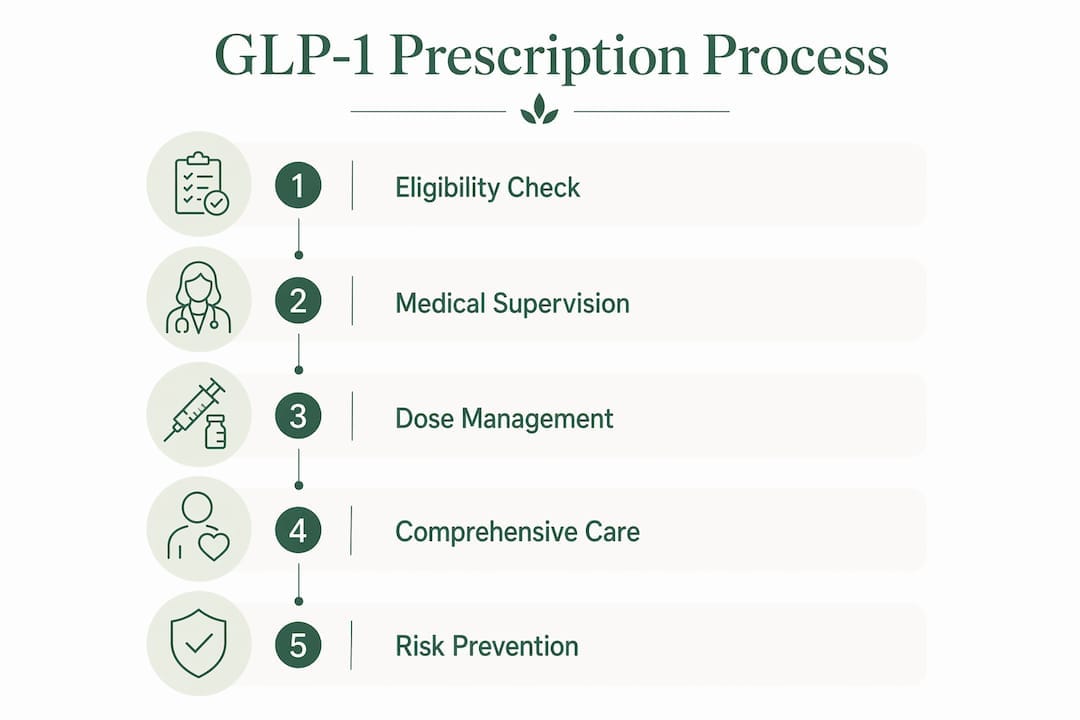
Why is medical supervision mandatory for safe GLP-1 prescribing?
Medical supervision is mandatory because GLP-1 medications alter appetite, digestion, and metabolic function in ways that require clinical monitoring. A prescription form on a website cannot do what a licensed clinician does in a real consultation.
The FDA has stated clearly that clinicians must use two-way communication modalities, such as video or in-person consultation, to verify eligibility and medical history before prescribing GLP-1 medications. Online-only intake forms are insufficient. Programs that bypass interactive screening are flagged as high-risk by medical oversight bodies.
A proper clinical evaluation covers the following steps:
- Verify height, weight, and BMI. Providers confirm these measurements through direct consultation or medical records rather than relying on patient-reported data alone. This protects against prescribing to patients who do not meet eligibility criteria.
- Review full medical history. Conditions such as a personal or family history of medullary thyroid carcinoma, pancreatitis, or severe gastrointestinal disease may contraindicate GLP-1 therapy.
- Screen for mental health conditions. Licensed providers are ethically and legally required to screen for eating disorders and body dysmorphia before prescribing. GLP-1 medications suppress appetite significantly, and that effect can worsen disordered eating in vulnerable patients.
- Assess current medications. Drug interactions, particularly with insulin and other glucose-lowering agents, require clinical judgment to manage safely.
- Confirm informed consent. Patients must understand the expected side effect profile, the titration schedule, and what to do if adverse reactions occur.
Pro Tip: Ask your provider directly whether they conduct a live video consultation before prescribing. If the answer is no, or if the process is entirely form-based, that is a signal to look elsewhere.
Digital questionnaires alone are insufficient for safe prescribing. Legitimate providers perform independent clinical verification through video consultations or medical record reviews. This standard protects patients and defines what a credible GLP-1 program looks like.
How do licensed providers manage GLP-1 dosing and ongoing treatment?
Dosing management is one of the most clinically demanding parts of GLP-1 therapy. Providers do not simply write a prescription and step back. They actively guide patients through a titration schedule designed to build tolerance while minimizing side effects.

For semaglutide, maintenance dosing typically ranges from 1.7mg to 2.4mg weekly, with titration intervals of at least four weeks adjusted for tolerability. Patients who escalate too quickly experience more nausea, vomiting, and gastrointestinal distress. Providers who understand this adjust the pace based on individual response, not a fixed schedule.
The provider's role in GLP-1 dosing includes:
- Titration oversight. Adjusting dose increments based on side effect burden and weight loss response at each follow-up visit.
- Side effect management. Addressing nausea, constipation, and fatigue with dietary guidance, timing adjustments, or temporary dose holds.
- Efficacy assessment. Evaluating whether the patient is responding to the current dose or needs escalation.
- Discontinuation planning. Providers manage transitions off medication with structured off-ramp strategies to sustain weight loss and reduce the risk of rapid regain.
- Documentation and follow-up scheduling. Maintaining a clinical record that tracks progress and flags concerns over time.
Pro Tip: If your provider does not schedule a follow-up within four to six weeks of starting or changing your dose, request one. Dose adjustments without monitoring increase the risk of unnecessary side effects.
Providers are not just prescription writers. They are ongoing managers of treatment, and the quality of that management directly affects how well GLP-1 therapy works over time.
What comprehensive care do licensed providers deliver beyond the prescription?
GLP-1 medications are licensed as adjuncts to a calorie-controlled diet and exercise, not as standalone treatments. The 2026 ADA guidelines specify that clinical success depends on a multimodal approach that integrates behavioral therapy, nutritional counseling, and physical activity guidance alongside medication. Providers who prescribe without addressing these components are not following current clinical standards.
One of the most underappreciated risks of GLP-1 therapy is muscle loss. Rapid weight loss induced by GLP-1 agents can result in significant lean mass reduction. Long-term success depends on providers recommending high-protein diets and strength training to mitigate this effect. The protein intake target is 80–120 grams per day, calibrated to body weight and activity level.
| Care component | Provider responsibility | Clinical purpose |
|---|---|---|
| Nutritional counseling | Recommend protein targets and caloric structure | Prevent muscle loss and nutrient deficiency |
| Physical activity guidance | Prescribe resistance and aerobic exercise | Preserve lean mass and support metabolic health |
| Behavioral therapy | Coordinate or refer for cognitive behavioral support | Address eating patterns and psychological drivers |
| Mental health screening | Assess for disordered eating and mood disorders | Prevent harm in psychologically vulnerable patients |
| Ongoing medical monitoring | Track labs, vitals, and weight at follow-up visits | Detect complications and confirm treatment response |
Providers also coordinate referrals when patients need support beyond what a single clinician can offer. A patient with a history of binge eating disorder, for example, may need concurrent work with a therapist before or during GLP-1 therapy. Recognizing that need and acting on it is a clinical responsibility, not optional guidance.
What risks do licensed providers prevent that patients cannot manage alone?
Patients cannot safely self-manage GLP-1 therapy. The risks are clinical, not administrative, and they require trained judgment to identify and address.
Unregulated online suppliers pose direct health risks by selling unverified or counterfeit GLP-1 products. Medical oversight bodies have flagged these sources repeatedly. A licensed provider acts as the first line of defense against exposure to unsafe products by ensuring medications come from verified, licensed compounding pharmacies.
Beyond sourcing, providers prevent the following categories of harm:
- Inappropriate prescribing. Patients who do not meet BMI or comorbidity criteria for GLP-1 therapy may still seek it. Providers enforce eligibility standards that protect patients from unnecessary risk.
- Missed psychological contraindications. Licensed providers detect psychological conditions that automated intake systems cannot. Body dysmorphia and active eating disorders are not visible on a weight chart.
- Unmanaged cardiovascular or gastrointestinal complications. Rare but serious adverse events require clinical recognition and response. Patients without provider access have no pathway to address these safely.
- Medication misuse. Without structured follow-up, patients may self-escalate doses, skip titration steps, or continue therapy past the point where it is appropriate.
- Relapse after discontinuation. Providers build structured transition plans to maintain results after stopping medication. Patients who stop abruptly without guidance frequently regain weight rapidly.
The provider's role is not bureaucratic. It is the clinical infrastructure that makes GLP-1 therapy safe enough to use.
Key Takeaways
A licensed provider's role in GLP-1 prescription extends far beyond writing a script. It encompasses eligibility verification, dosing management, psychological screening, and coordination of the full care plan that determines whether treatment succeeds.
| Point | Details |
|---|---|
| Two-way consultation is required | Video or in-person verification of eligibility is mandatory; intake forms alone do not meet clinical standards. |
| Dosing is actively managed | Semaglutide titration from 1.7mg to 2.4mg weekly requires provider-guided adjustments at minimum four-week intervals. |
| Mental health screening is non-negotiable | Providers must screen for eating disorders and body dysmorphia before prescribing GLP-1 medications. |
| Comprehensive care is the standard | The 2026 ADA guidelines require behavioral therapy, nutritional counseling, and physical activity alongside medication. |
| Providers prevent serious harm | Licensed clinicians block access to counterfeit products, catch contraindications, and manage off-ramp transitions. |
Why provider education is the real bottleneck in GLP-1 care
From the Ozari Health Editorial Team's perspective, the most underreported problem in GLP-1 prescribing is not patient demand. It is prescribing hesitancy linked to insufficient clinician education about comprehensive obesity management. Many providers who could prescribe GLP-1 medications do not, because they were trained in an era when obesity was treated primarily through diet advice and referrals. That gap leaves patients without access to care that is clinically appropriate for them.
What patients often misunderstand is that a good provider is not a gatekeeper blocking access. A good provider is the reason treatment works. The clinical relationship, the follow-up, the dose adjustment, the conversation about protein intake and muscle preservation, these are not extras. They are the mechanism. Medication without that structure produces inconsistent results and higher dropout rates.
The other thing patients frequently underestimate is the off-ramp. GLP-1 therapy is not indefinite for most patients. Planning the transition off medication, with a provider who has tracked your progress and knows your history, is as important as the prescription itself. Patients who skip that step often end up back where they started within months.
The bottom line: the quality of your provider relationship is the single biggest variable in your GLP-1 outcome. Choose accordingly.
— Ozari Health Editorial Team
GLP-1 care with Ozari Health: licensed providers, transparent pricing
Ozari Health connects patients across all 50 states with licensed providers who conduct real eligibility reviews, not just intake forms. Every consultation meets the clinical standards described in this article, including live provider review, medical history verification, and ongoing dosing support.

Compounded semaglutide is $86/mo on Ozari One, billed $258 every 3 months. Compounded tirzepatide is $125/mo on Ozari One, billed $375 every 3 months. Ozari One ships to every state except California; California patients use Ozari Select, $145/mo billed quarterly for semaglutide or $199/mo for tirzepatide. Both medications are fulfilled through licensed US compounding pharmacies and delivered directly to patients, with no insurance required and no hidden fees. Ozari Health's GLP-1 medication options cover both agents, with published pricing and named pharmacy partners. Patients who want to understand the full scope of treatment before starting can review clinical evidence and pricing data on the Ozari Health platform.
FAQ
Who can prescribe GLP-1 medications in the US?
MDs, DOs, NPs, and PAs can all prescribe GLP-1 medications, provided they hold an active license in the patient's state. Telehealth providers must meet the same state licensure requirements as in-person clinicians.
What does a licensed provider check before prescribing a GLP-1?
Providers verify BMI, medical history, current medications, and screen for contraindications including eating disorders and thyroid conditions. The FDA requires this verification to occur through two-way communication such as a video consultation, not a digital form alone.
How often should a provider follow up during GLP-1 therapy?
Follow-up should occur at minimum every four to six weeks during active dose titration. Providers use these visits to assess tolerability, adjust dosing, and monitor for side effects or complications.
Can a patient manage GLP-1 dosing without a provider?
No. Titration schedules, side effect management, and off-ramp planning all require clinical judgment. Self-managed dose escalation increases the risk of adverse reactions and reduces the likelihood of sustained results.
What is the provider's role after a patient stops GLP-1 medication?
Providers build structured transition plans that include nutritional guidance, physical activity recommendations, and follow-up monitoring to reduce the risk of weight regain after discontinuation.
Sources
- Only about 25% of physicians
- FDA has stated clearly
- screen for eating disorders
- insufficient for safe prescribing
- Providers manage transitions off medication
- licensed as adjuncts to a calorie-controlled diet and exercise
- clinical success depends on a multimodal approach
Medical Disclaimer: This article is for informational purposes only and does not constitute medical advice. Always consult a licensed healthcare provider before starting, changing, or stopping any medication. Reviewed by Dr. Michael Wasef, MD, Board-Certified Internal Medicine, Florida License ME125730.
Related Articles
Men: Fella Health Safety Risks, Real Costs, and an $86 Alternative
A safety-first look at Fella Health for men: why compounded GLP-1s show higher FDA reporting risks, how to calculate all-in monthly cost, and an $86 Ozari...
Read more →generalHallandale Semaglutide vs Tirzepatide: What Patients Should Know
Compare the compounded semaglutide and tirzepatide formulations Hallandale currently lists, including concentrations, regulatory status, dosing differences, and Ozari fulfillment.
Read more →generalHallandale Pharmacy Shipping: Delivery, Packaging & Storage Guide
How Hallandale Pharmacy fulfillment works, what to check when a GLP-1 shipment arrives, storage guidance, delays, and Ozari order support.
Read more →