GLP-1 Weight Loss Clinical Evidence Explained
Published July 2, 2026

GLP-1 receptor agonists are proven medications that reduce body fat by suppressing appetite, slowing gastric emptying, and modulating fat metabolism at the cellular level. The GLP-1 weight loss clinical evidence explained across major trials shows that patients with a BMI of 27 or higher can expect meaningful, measurable fat loss within the first three months of treatment. A meta-analysis of 36 studies found that GLP-1 agonists reduce body weight by approximately 9% at three months, with consistent reductions in BMI and waist circumference across agents including semaglutide, liraglutide, and tirzepatide. That figure matters because it reflects fat mass loss, not just water weight or lean tissue. Understanding what the research actually shows helps you set realistic expectations and choose the right therapy for your situation.
How do GLP-1 medications biologically promote weight loss?
GLP-1 receptor agonists work through three distinct biological pathways, and each one contributes to a sustainable caloric deficit. This is what separates them from diet-only approaches, where hunger typically increases as weight drops.
The three core mechanisms are:
- Central appetite suppression. GLP-1 receptors in the hypothalamus and brainstem receive signals that reduce hunger and increase the feeling of fullness after eating. The result is a lower drive to eat, not just willpower.
- Delayed gastric emptying. Food moves more slowly from the stomach to the small intestine. This extends the sensation of fullness after each meal and reduces total calorie intake without requiring calorie counting.
- Visceral fat mobilization. GLP-1 agonists favor adipose tissue utilization over lean muscle breakdown. This is the metabolic distinction that makes GLP-1 weight loss qualitatively different from caloric restriction alone.
A Stanford Medicine review confirms that the combination of central hunger suppression and gut motility modulation makes the caloric deficit sustainable over time. Diet-only approaches create a deficit, but rising hunger hormones like ghrelin typically erode adherence within months. GLP-1 medications blunt that rebound hunger signal directly.
Pro Tip: If you experience nausea in the first few weeks of GLP-1 therapy, it is usually a sign that gastric emptying is slowing as intended. Eating smaller, lower-fat meals during dose escalation reduces discomfort without reducing effectiveness.

One underappreciated aspect of this mechanism is the difference in muscle preservation. Clinical trial data show that muscle loss during GLP-1 treatment mirrors diet-only loss in absolute terms, but the key difference is that hunger control remains intact. Patients can sustain the deficit long enough for fat loss to dominate the composition change.
What does clinical research reveal about GLP-1 weight loss results?
The clinical evidence on GLP-1 weight loss results is more nuanced than headline numbers suggest. Weight loss is front-loaded, and the rate of loss slows as the body adapts. Understanding that pattern prevents patients from misreading a plateau as treatment failure.
Weight loss trajectory across time
A meta-analysis of 36 clinical studies produced the following findings on mean weight reduction from baseline:
| Timepoint | Mean weight loss | Primary driver |
|---|---|---|
| 3 months | ~9% of body weight | Rapid appetite suppression and caloric deficit |
| 6 months | ~5% of body weight | Continued fat loss, metabolic adaptation begins |
| 12 months | ~4% of body weight | Plateau phase, maintenance dosing required |
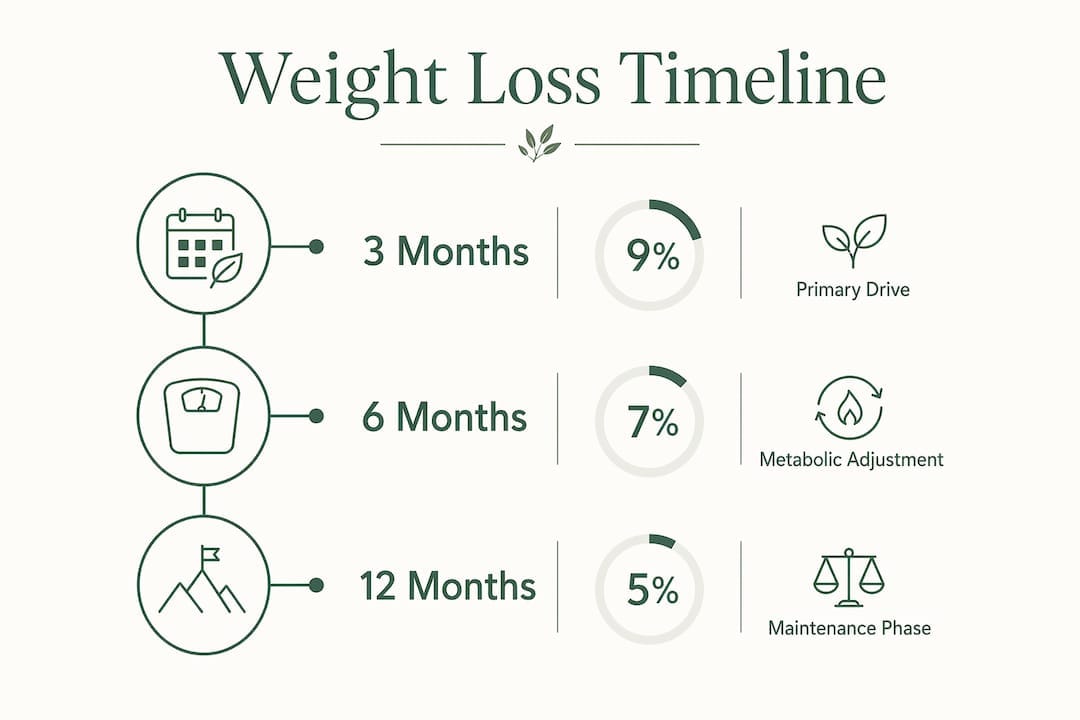
The declining percentages do not indicate that the medication stops working. They reflect the body reaching a new energy equilibrium. Patients who continue therapy maintain their lower weight; those who stop typically regain.
Body composition: fat versus lean mass
The most clinically significant finding in GLP-1 research is not total weight lost. It is what is lost. GLP-1 agonists selectively reduce visceral adipose tissue while preserving lean muscle mass to a greater degree than caloric restriction alone. Visceral fat is the metabolically active fat stored around internal organs, and its reduction lowers cardiovascular risk, improves insulin sensitivity, and reduces systemic inflammation.
Key body composition findings from clinical studies on GLP-1 include:
- Fat mass reduction accounts for the majority of total weight lost across all agents studied.
- Lean mass loss is proportionally smaller than in diet-only interventions at equivalent caloric deficits.
- Waist circumference reductions are consistent across semaglutide, liraglutide, and tirzepatide trials, confirming visceral fat as the primary target.
This is what clinicians mean when they describe GLP-1 therapy as producing "quality weight loss." The plain-English definition of this term is weight loss that improves metabolic health markers, not just the number on a scale.
Pro Tip: Ask your provider to track waist circumference and fasting insulin alongside body weight. These metrics often show improvement before the scale reflects meaningful change, and they confirm that fat, not muscle, is being lost.
How do dual agonists like tirzepatide compare to selective GLP-1 drugs?
Tirzepatide is a dual GIP/GLP-1 receptor agonist, meaning it activates two separate metabolic pathways simultaneously. Selective GLP-1 agonists like semaglutide activate only the GLP-1 receptor. That additional GIP receptor activation produces measurably greater weight loss and glycemic improvement in head-to-head clinical comparisons.
Recent clinical trial data confirm that dual GIP/GLP-1 agonists produce superior weight loss and better glycemic control compared to selective GLP-1 drugs. The practical implication is that patients with type 2 diabetes or insulin resistance may see compounded benefits from tirzepatide that go beyond weight reduction alone.
Comparing selective GLP-1 agonists and dual agonists
| Feature | Selective GLP-1 agonists | Dual GIP/GLP-1 agonists |
|---|---|---|
| Receptors targeted | GLP-1 only | GLP-1 and GIP |
| Mean weight loss | Clinically significant | Greater than selective agents |
| Glycemic control | Improved | Superior improvement |
| Visceral fat reduction | Confirmed | Confirmed, greater magnitude |
| Side effect profile | Primarily GI | Similar GI profile, generally well tolerated |
The SURMOUNT-MAINTAIN trial provides the clearest evidence on sustainability. Patients who continued tirzepatide after reaching their goal weight maintained their loss. Those who switched to placebo regained weight rapidly. This finding applies broadly: the medication is a long-term tool, not a short course.
A detailed comparison of newer co-agonists against tirzepatide is available for patients evaluating next-generation options. Patient suitability for dual agonists depends on individual metabolic profile, comorbidities, and provider assessment.
What are the challenges of maintaining weight loss after GLP-1 therapy?
Weight regain after stopping GLP-1 therapy is well documented and clinically predictable. Obesity is a chronic, relapsing condition, and discontinuing GLP-1 treatment without a structured maintenance plan causes rebound weight gain faster than most other weight loss methods. The biology is straightforward: when the medication stops suppressing appetite, hunger returns to pre-treatment levels.
Strategies that clinical evidence supports for long-term weight maintenance include:
- Ongoing therapy at maintenance dose. The SURMOUNT-MAINTAIN trial shows that tapering to a lower dose after reaching goal weight sustains results while reducing side effects. Treatment is a titration process, not a binary on/off decision.
- Strength training to preserve muscle. Clinical guidance from the Cleveland Clinic recommends combining GLP-1 pharmacotherapy with resistance exercise to maintain metabolic rate and physical function during and after weight loss.
- Dietary protein prioritization. Higher protein intake during GLP-1 therapy supports lean mass retention, which protects resting metabolic rate as total weight decreases.
- Regular provider monitoring. Dose adjustments based on weight trends, side effects, and metabolic markers improve long-term outcomes compared to fixed-dose protocols.
Individual metabolic profiles affect how quickly patients respond and how well they maintain results. Response variability between agents and between patients is well established in the literature. This is why personalized dosing and ongoing clinical oversight are not optional extras. They are the mechanism by which long-term GLP-1 weight maintenance is achieved.
Key Takeaways
GLP-1 receptor agonists produce clinically significant fat loss by suppressing appetite and selectively reducing visceral adipose tissue, with dual agonists like tirzepatide delivering superior results and ongoing therapy being necessary to prevent weight regain.
| Point | Details |
|---|---|
| Front-loaded weight loss | Patients lose approximately 9% of body weight at 3 months, with the rate slowing as the body adapts. |
| Quality fat loss | GLP-1 agonists preferentially reduce visceral fat while preserving lean muscle, improving metabolic health markers. |
| Dual agonists outperform | Tirzepatide activates both GLP-1 and GIP receptors, producing greater weight loss and glycemic control than selective agents. |
| Discontinuation causes regain | Stopping GLP-1 therapy without a maintenance plan leads to rapid weight rebound due to returning appetite signals. |
| Long-term therapy is the standard | Maintenance dosing or dose tapering, combined with strength training and dietary support, sustains results over time. |
What the clinical data actually tells you about realistic outcomes
A common misconception is that GLP-1 medications produce weight loss independently of patient behavior. The clinical trial data does not support that reading. What the trials show is that GLP-1 agonists create the biological conditions for weight loss by removing the hunger barrier that makes caloric deficit unsustainable. Patients still need to use that window through adherence and lifestyle support.
The 9% weight loss figure at three months is a mean across a diverse population. Individual responses vary considerably based on starting BMI, metabolic health, the specific agent used, and adherence to dose escalation schedules. Some patients lose significantly more. Others plateau earlier. Response variability between agents is documented in the literature, and it is one of the strongest arguments for individualized treatment rather than a fixed protocol applied to everyone.
The evidence on long-term maintenance is where many patients are underserved by the information available to them. Stopping the medication at goal weight and expecting results to hold is not a strategy the clinical data supports. The chronic disease model of obesity treats GLP-1 therapy the way cardiology treats antihypertensives: as ongoing management, not a cure. Patients who understand this from the start make better decisions about dosing, lifestyle integration, and long-term planning.
The practical takeaway is this: GLP-1 medications are among the most effective pharmacological tools available for obesity management. They work best when paired with strength training, adequate protein intake, and a provider relationship that adjusts dosing over time. The clinical evidence is clear. The implementation requires commitment.
GLP-1 options available through Ozarihealth
Ozarihealth connects patients in all 50 states with licensed providers who assess eligibility and prescribe compounded GLP-1 medications with no insurance required and no hidden fees.
Patients can access compounded semaglutide at $86/mo or compounded tirzepatide at $125/mo on Ozari One, billed $258 or $375 every 3 months, fulfilled through licensed US compounding pharmacies and delivered directly to your door. Ozari One ships to every state except California; California patients use Ozari Select, $145/mo billed quarterly for semaglutide or $199/mo for tirzepatide. Ozarihealth's LegitScript-certified platform includes ongoing clinical support for dosing adjustments, side effect management, and refills. For patients who want to review the underlying trial data before starting, the GLP-1 pricing and trial data page provides transparent access to clinical evidence and cost breakdowns.
FAQ
What is a GLP-1 receptor agonist?
A GLP-1 receptor agonist is a medication that mimics the glucagon-like peptide-1 hormone, suppressing appetite and slowing gastric emptying to reduce calorie intake and promote fat loss. Semaglutide and tirzepatide are the most widely prescribed agents in this class.
How much weight can you expect to lose on GLP-1 medications?
Clinical studies show a mean weight loss of approximately 9% of body weight at three months, with continued but slower loss through six and twelve months. Individual results vary based on the agent used, starting BMI, and adherence to dosing.
Does GLP-1 therapy cause muscle loss?
GLP-1 agonists primarily reduce visceral fat while preserving lean muscle mass to a greater degree than diet-only approaches. Combining GLP-1 therapy with resistance training and adequate protein intake further protects muscle during weight loss.
What happens when you stop taking a GLP-1 medication?
Stopping GLP-1 therapy without a maintenance plan leads to rapid weight regain because appetite returns to pre-treatment levels. The SURMOUNT-MAINTAIN trial confirms that continuing at a maintenance dose or tapering gradually sustains weight loss and cardiometabolic benefits.
Is tirzepatide more effective than semaglutide for weight loss?
Clinical trial data show that tirzepatide, a dual GIP/GLP-1 receptor agonist, produces greater weight loss and improved glycemic control compared to selective GLP-1 agonists like semaglutide. Patient suitability depends on individual metabolic profile and provider assessment. You can review a detailed medication FAQ for a full comparison of both agents.
Sources
- meta-analysis of 36 studies
- Stanford Medicine review
- Recent clinical trial data
- SURMOUNT-MAINTAIN trial
- discontinuing GLP-1 treatment
- Clinical guidance from the Cleveland Clinic
Recommended
Related Articles
Men: Fella Health Safety Risks, Real Costs, and an $86 Alternative
A safety-first look at Fella Health for men: why compounded GLP-1s show higher FDA reporting risks, how to calculate all-in monthly cost, and an $86 Ozari...
Read more →generalHallandale Semaglutide vs Tirzepatide: What Patients Should Know
Compare the compounded semaglutide and tirzepatide formulations Hallandale currently lists, including concentrations, regulatory status, dosing differences, and Ozari fulfillment.
Read more →generalHallandale Pharmacy Shipping: Delivery, Packaging & Storage Guide
How Hallandale Pharmacy fulfillment works, what to check when a GLP-1 shipment arrives, storage guidance, delays, and Ozari order support.
Read more →